Bosh! Bosh!! BOSH!!!

Remarkably, not changing tactics and changing personnel worked a treat for the Bokke and the Bloody Nice Chaps (except Delon Armitage). Actually, not so remarkable when you consider the best sides at club level have nailed that one a long time ago. Still, one lesson is that if boshing up the middle doesn’t work, just get other lads to try it instead. New Zealand and Australia certainly won’t mind that conclusion being reached.

Today, on Back Page Rugby, we looked at how Johnno and P Divvy made a difference from their goldfish bowls – plus we don’t think Johnno destroyed anything while he was there as an added bonus.

Read it here.

Frankie Says ‘Relax, We Have the Pishun’

The early mornings aren’t easy – before you ask, no, we didn’t get up at 4.30 to watch Fiji v Namibia – but the first weekend was so good it was a pleasure to leave the scratcher.  Here’s a few things we learned over the first set of World Cup games:

1. Ireland are in trouble.  They destroyed the US scrum, took apart their lineout and mauled them at will, but could only muster three tries against one of the weakest sides in the tournament.  The lack of gameplan, skill, intelligence and support for the carrier was galling.  It’s sad to see so many good players playing so poorly. There is no basis on which to believe Ireland can trouble Australia.  Indeed, there is every chance Ireland will once again fail to get out of the group.

2. Hooray for the little teams!  Every one of the underdogs beat the spread.  Remarkably, the gap between the second and top tiers looks to have closed.  Romania were leading Scotland with 10 minutes to go, Japan got to within four points of France midway through the second half, and USA hung in for a late intercept to reduce Ireland’s winning margin to 12.  A genuine shock is on the cards.  Look no further than Wednesday morning, when a Scotland side with 11 changes and no Richie Gray takes on a feral Georgian pack including Mamuka Gorgodzilla, a world class scrum and a bunch of other grizzled Top 14 henchmen.

3. RTE’s choice of pundits is diabolical.  Watching the analysis of the highlights of Sunday’s action on RTE was a dispiriting experience.  Shane Horgan is no doubt a great player and a nice guy who looks good on TV, but what was he going to say, that his Leinster teammates and good friends had played like drains?  He’s too close to the players to offer anything.  Next to him we had our beloved Frankie Sheahan, a man for whom the word optimistic doesn’t do justice.  He assured viewers that the underdog spirit will inspire huge pishun in the Irish team, and that alone would beat Australia. It was left to Conor O’Shea to add some sensible commentary; he noted that all the evidence available points to an easy Australia victory.  We’re sticking to Matty and Franno.

4. Heroes in defeat were numerous.  The man of the match award could have gone to a losing player in any number of games.  Few Scots will forget Romania’s teak-tough hooker Marius Tincu for some time, while USA’s all-action flanker Todd Clever repelled Irish runners all day.  Tonga’s reserve prop Taumalolo carried the fight to New Zealand, and Japan’s scrum half Fumiaka Tanaka gave real impetus to their commendable running game.  Nobody deserved to lose less than Wales’ Sam Warburton, however.  The Welsh openside is almost impossible to dislodge from rucks – he dominated Heinrich Brussouw, the man who has been dominating Richie McCaw. He looks a star in the making, and an early runner for the Lions captaincy in 2013. 

5. New Zealand v Australia final looks inevitable.  It’s already impossible to see beyond a final involving these two wonderful teams.  None of their rivals even come close.  France look like they could wreak havoc, but can’t stay awake for the full 80 minutes.  England were ponderous and allowed themselves to be drawn into a pitch battle.  Ireland were hopeless and South Africa were deeply fortunate to beat Wales.  The passing, support running and execution of the Antipodeans is unmatched.

It’s here!! (Well, almost)

The Rugby World Cup starts tomorrow.  We’ve been building up to this moment all summer.  The Ovale clan is heading down under on tuesday for three weeks, so Palla will be ‘our man on the ground’.  Expect to see updates from his ‘World Cup Diary’.  Meanwhile, Egg Chaser will be looking after the Good Ship Cordite back home.  Our predictions and forecasts are in, New Zealanders are already panicking about not winning, and all that remains is to somehow watch the thing.  The kick-off times aren’t conducive to pint-swilling down in the pub, so what’s the best approach to enjoying the games at such alien hours?  Here’s a handy guide.
1.  Get Sky+ or UPC equivalent.  Nobody wants to be up at 4.30 in the morning to watch Fiji v Namibia.  Get in the recording facility, even if just for the month, and give yourself the option of watching it at a more reasonable hour.  You can fast forward through the endless scrum resets too.
2. Buy in breakfast beforehand.  Getting out of bed at 7am to watch France v Tonga is a tricky assignment, but that’s only half the battle.  Staying awake once you’re on the couch is entirely another matter.  It’s important to have the right breakfast.  Invariably that involves lots of protein and not so much carbohydrate, which is likely to induce food coma.  Think Bertie Wooster (eggs and bacon) rather than The Inbetweeners (rounds of toast).  And a pot of hot coffee is, of course, essential.  Bright light bulbs and a cool room are also likely to stop you nodding off.

3. Parents, take advantage!  If, like both WoC scribes, you have little people running around your house, you’re at a massive advantage.  7am wake up call, you say?  What’s new about that?  Take the easy brownie points on offer and watch the rugby (or ‘fighting’ as Little Ovale calls it) while your spouse enjoys a lie-on.

4. Take a power nap.  If you’re planning to watch Scotland v Romania at 2am in the morning, don’t try staying up all the way.  Chances are you’ll do the hard work and your eyes will fold over at around 1.35am.  Sleep cycles are four hours, so get to bed at 10pm for four hours and you’ll wake up feeling not so dreadful.

5. And finally, have Twitter open!  We’ll be tweeting our thoughts on as many games and key moments as we can manage.

One more sleep!  One more sleep!  One more sleep!

World Cup Preview: Ireland

Group C Opposition: Australia, Italy, USA and Russia

Pedigree: Very disappointing.  Ireland have never been beyond the quarter finals, and have twice been dispatched in the group stages, on both occasions by Argentina.  The only time Ireland went close to a semi-final was when Gordon Hamilton scored that try…

Players to watch: it increasingly looks like all hopes will be pinned on Sean O’Brien.  The Tullow Tank was the outstanding player in Europe this year, and if he can use his explosive carrying ability to blow away Southern hemisphere defences, then we will have a world star on our hands.  He’ll probably have to do it from the openside flank though, where he never appears quite the same player.  In the back division, only Andrew Trimble managed to play his way into the squad.  He’s a strong, hard running wing with much improved feet and hands.

Good tournament: If Ireland can finally make it to a semi-final Deccie will be back in the nation’s good books.

Bad tournament: Ireland should get out of a fairly benign group even if they underperform – if they get to the last eight, but are hammered by both Australia and South Africa, it will go down as a failure.

Prospects: Let’s be honest, they’re not great.  Ireland is a nation of optimists, and the majority of the media spent the summer talking up Ireland’s chances of beating Australia, and setting up a potential path to the semi final and – who knows? – beyond that.  Much of it seemed to be based on Ireland’s performance against England in this year’s Six Nations, when everything appeared to click and Ireland tore England to shred, beasting them up front and playing at a pace that England’s ponderous midfield couldn’t handle. 

But even a cursory glance at the data reveals this game as a complete outlier – Ireland were poor in every single other game this season.  The Autumn series was a wasted opportunity (zero minutes for Mike Ross, one game against Samoa for Sean O’Brien).  In all four other Six Nations games they were ordinary, and in the most recent warm-up games simply abysmal.  Even the Cork Con Mafia are no longer so optimistic.

Kidney’s idiosyncratic selections have bemused us in the past, but the squad selection showed his willingness to make the hard calls.  It’s now a question of gameplan.  The backs, coached by the ageing Alan Gaffney, are playing a wide-wide game with little depth, plenty of lateral running and little penetration.  One-out forwards rumble into contact, and the ball goes back and forth across the pitch.  It’s awful to watch and easy to defend.  It’s Scotland.

Nobody should be fooled into false hope because Ireland have been holding back a few set-piece moves.  The number of times these can be used in a match is not enough to make a huge difference.  Besides, they’ll be Gaffney’s moves, and the current style is Gaffney’s style.  Leinster fans will recognise it from the low try-scoring 2008-2010 era, when he was the backs coach.  Given Ireland’s lack of pace, we would love to see a game based on offloading, support runners and quick recycling – in other words, the game Joe Schmidt brought to Leinster.

Verdict: Ireland generally produce their best when pinned into a corner.  Expect them to run Australia closer than you might expect, but come up short.  The opposite will occur in Dunedin, and the Italy game will be tight.  Ireland should have enough to scrape by, but South Africa in the quarter finals will be a step too far.  A familiar quarter-final exit.

Stop Press! (Except the Online Ones)

It seems unfair to concentrate on the players, what with so many others putting their heart and soul into this World Cup. There’s been demand for Maori chiefs to welcome competitors at airports, astronauts to retrieve Morne Steyn’s kickoffs and Bayonne butchers wondering why Shontayne Hape is wearing their products on his hands.

Spare a thought also for the scribes and TV pundits covering the tournament – they have been forced to undergo an all-expenses-paid trip away from the Trouble and Strife for a month to watch rugby and drink Marlborough Savugnon Blanc. To cheer them up, we have put together a RWC preview of our favourite hacks and Stephen Jones.
 

Matt Williams (Setanta)

Style: Tends to start with a rabbit-on-the-headlights never-been-on-TV look, but then relaxes into matey banter with Franno. His perfect teeth and healthy tan cover a razor-sharp rugby mind, and his snippets of insider knowledge gleaned from his time in D4 and Ravenhill are always interesting.

Likely to say: Paddy Wallace is an amaaaaaaaaaaaaazing playah, reaaaaaaaaaaaaaally underaaaaaaaaaated
Unlikely to say: Let’s refer to New Zealand as the All Blacks

Jeremy Guscott (BBC)
Style: Self-satisfied, smug, paunch-bearing know-it-all. His judgement can best be summed up by his pre Six Nations verdict on Richie Gray – “He looks like he is running through treacle”. Errrr. Egg Chaser and his brother used to e-mail his BBC column with praise of rubbish players to see if he’d agree – our bigging up of Ayoola Erinle was a notable success.

Likely to say: Brian O’Driscoll isn’t a patch on the outside centre the 1997 Lions had
Unlikely to say: Interesting opinion Inverdale, I’ll take that on board

Ryle Nugent (RTE)
Style: Excited, excitable and exciting, roysh. Ryle has the refined voice and fur-lined coat of a man who has never left South Dublin in his life. His vocal range is huge, and one can generally tell how Ireland are doing merely by listening to the tone of his voice – anything mezzosoprano and above is good.

Likely to say: You beauty!!
Unlikely to say: Bring rugby back to the Northside 

Frankie Sheahan (RTE)
Style: Fiercely neutral and fair in his commentary, he rarely allws the origins of a player to dictate his opinion of them. No matter what you think of Frankie, you can’t argue that players from Cork and Limerick don’t get treated equally in his eyes. His day job is acting as agent for, among others, David Wallace and Tomas O’Leary – expect many references to how much they are being missed (truthful ones in Wally’s case).

Likely to say: Mick O’Driscoll is very unfortunate not to be here

Unlikely to say: What a performance from Jonny Sexton!

Stuart Barnes (Sky Sports)
Style: Surprisingly for a Sky commentator, over-enthusiastic and a strong backer of whatever Sky have the rights for at the time. When you push through the bluster, he’s actually a very shrewd and interesting analyst. Provided Whiff of Cordite with their favourite commentary moment last year in the Leicester-Perpignan game, as they discussed the collective noun for Tuilagi’s (winner: a terror of Tuilagi’s). While they talked, both Henry and Alesana took the ball directly into contact and got turned over.

Likely to say: I know Matt Banahan knocked on, but what power!
Unlikely to say: I know Matt Banahan is powerful, but what’s the point if you have hands like soap!

George Hook (RTE)

Style: Committed to saying the first thing that comes into his head, unless that happens to be a criticism of Munster. Specialises in popping some of the over-exuberant balloons inflated by the Irish press, but has morphed into a cynical parody of himself. Struggles to admit when his far-flung predictions turn out entirely incorrect.  The Irish players despise him.

Likely to say: We’ll get destroyed up front and lose
Unlikely to say: Keep the faith Tom

Stephen Jones (Sunday Times)
Style: Pointless curmudgeon who persists in his outrageously biased nonsense. To be fair, he makes great copy, and we don’t know if it’s us getting older or him getting more mellow, but we have found ourselves in agreement more than is healthy of late.

Likely to say: McCaw is running scared of the intensity of Edgely Park and Sixways by staying with the Crusaders
Unlikely to say: James Hook needs to improve his decision-making on the field

Gerry Thornley (Irish Times)

Style: Torn between Southside chic and Indie cool (Ms Ovale admits to a minor crush), Gerry can often be seen puffing on a Marlboro Light outside O’Donoghues. Favours the stubble, sunglasses and scarf look. Used to be Head Boy at St Deccie’s but has been usurped in favour of Fanning, despite fervent support for the regime. In fact, fervent support of pretty much everything Irish can be guaranteed.

Likely to say: I had to restrain Dave Pearson from licking Wilkinson’s boots roysh
Unlikely to say: Rugby is now a 22 man game, and Deccie needs to learn that

Lets hope the poor dears survive their tourism – Palla will be keeping a beedy eye out for photo ops, especially with Barnesy.

Needless to say, this blog also has a deep connection to Gerry, and we will watch with interest the reaction to his demotion – will he knuckle down and praise the junta more than ever, or actually begin to call the Great Leader out on his mistakes?

Charity Begins at Home

The most glamorous, long-awaited and exciting rugby tournament in the world is just eight days away.  For the likes of Luke Fitzgerald, David Strettle and Tomas Domingo, however, the next two months will be spent playing in their domestic leagues.  Yes, the Magners League Rabodirect Pro12 kicks off this weekend.  The Premiership also gets up and running, and the gruelling Top 14 has already started.  Here’s a quick preview of what we can expect over the domestic season, and in particular the first few weeks when the big boys are away.
Top 14
The Top 14 is generally best watched at the beginning of the season, when the tracks are relatively firm, and the end, when the high-profile and passionate finale is unmatched by any other club tournament – witness last year’s semi-finals in Marseille.  In the winter months it tends to turn into something of a drop goal competition, as packs are content to scrummmage for 80 minutes, and the likes of Wilkinson, Winiewski and Skrela sit dee in the pocket…

Possible winners: Toulouse and Clermont will always be in or around the playoff spots, and Perpignan and Biarritz will be looking for an improvement on last year’s mediocrity.  But this will surely be the year Toulon‘s riches finally tell.  They were pretty dire to watch last term, but a new coach (still unknown) will arrive to allow Phillips Saint-Andre to take the reins of the national team.  They’ve recruited exceptionally and have no Heineken Cup to distract them.  Already up and running, they beat Biarritz 20-5 in their first game.  Pilous, pilous!

Player to watch: Matthieu Basteraud finds himself at – where else? – Toulon in a bid to reignite his international career.  If he stays fit and focused there should be no stopping him.

Premiership

Ooooooooooooooooohhh!  You can almost hear Barnesy warming up his larynx for the shuddering hits and slow-paced slugfest that is the Premirship.  With the Sky-hype behind it, even the most mundane 6-3 win for Exeter over Sale is a classic.  Ok, so the Premiership isn’t really that awful – surely watching the Dragons v Connacht on a wet Friday night isn’t any better? – and we can’t help but love Barnesy and his customary roar as Oooooooooohhh! Jordan Turner-Hall! puts in yet another collosal hit on Jeremy Staunton.

Possible winners: It’s hard to see beyond Leicester, Northampton and Saracens.  Leicester look in the best nick – with Anthony Allen and Manu Tuilagi they have a genuinely exciting midfield.  They should be hungry after losing their title last year, and will be out for vengeance.

Player to watch: Matthew Tait is still only 25, but feels like he’s been around forever.  Finally, he has arrived at a club where he can fulfil his potential.  Possessed of a natural talent that few English rugby players can match, we would dearly love to see him deliver.

Rabodirect Pro12

Now rebranded, and hopefully, delivering more of a shake-up than last year, when the teams appeared to file into an Irish-Welsh-Scottish-Italian order.   The best hope of upsetting the order look to be the Scarlets, who have spent two years developing a talented and exciting team, which now looks primed to challenge for silverware.  Treviso will be looking to build on last season’s strong home form, and Aironi will be hugely improved.  But whither Scotland?  With Max Evans headed for Castres, Glasgow could be weaker again this year.

Possible winners: Munster have shed much of their deadwood, but could be set for a transitional season, blooding several young players.  It’s hard to see them being as consistent as last year.  Leinster are the most affected by World Cup call-ups, but if they can avoid last year’s terrible start they will be in the shake-up.  Ulster‘s upsurge will continue – their outstanding young backs will be a year older, and Mueller and Pienaar will be around to guide them post-world cup.  Afoa and Jared Payne are outstanding recruits, and if Ferris can stay fit, they could go one or two steps better than last year.

Player to watch:  Rhys Ruddock will captain Leinster in the first few weeks, a massive endorsement of his talent.  A naturally built specimen, he will be expected to provide the ball-carries for Leinster while Sean and Jamie make hay down under.  Both he and Dom Ryan should be challenging for starting shirts for the big games, and even Ireland, this year.

World Cup Preview: Fiji & Namibia

Group D Opposition: South Africa, Wales, Samoa

Pedigree: With a very respectable history at this tournament, Fiji are twice quarter-finalists, most recently in 2007. Despite having no right to be on the same field as the Springboks (copyright Jacque Fourie), they were far from disgraced in a 37-20 defeat, having earlier disposed of Wales in the pool stages.

This will be Namibia’s 4th successive finals, although they have no wins to report – their best result being the 17-32 humiliation wreaked on Eddie’s Ireland in Bordeaux. To put that in context, their next best results are 30-point defeats to Romania and Georgia, and their worst was 0-142 against the Wallabies in 2003.

Players to watch: Fijian flyer Napolioni Nalaga intimidated much of Europe as part of an all-conquering (well, all except Munster and Leinster) Clermont side, but he failed to return from holiday, then said he was suffering from depression, and ended up being let go. His whereabouts were a mystery until he appeared (and scored two tries) at the PNC – lets hope he is back in full fitness (mental and physical) and his best. Anyone who has watched Racing Metro this season has probably seen Albert VuliVuli get a yellow card for a high tackle – the man is a powerful centre and should love the Bokkebosh game.
If you were told of a Jacques Burger who plays for Saracens, you might guess his nationality as Seth Efrican. But you’d be wrong – he’s Namibian, like Percy Montgomery. Although he’s unlikely to emulate Percy’s 2007 feats. Namibia also have a hooker who has piqued our interest – a man called Egbertus O’Callaghan. We wonder does he give away dumb penalties when Namibia have the opposition under control? If so, we have a funny feeling we know one of his distant cousins…

Good tournament: For Fiji, another quarter-final will be the expectation, and they have respectable records against all of the bigger guns in this pool. Namibia will hope to get away with their dignity intact.

Bad tournament: For Fiji, losing to both Wales and Samoa is the worst-case scenario. Namibia will fear having a century put on them by the notoriously sympathetic-to-the-underdog South Africa – and having the ability to speak the same language as Bakkies Botha is not necessarily a good thing.

Prospects: In one sense, it’s harsh to put these teams together as, unlike some of our other minnows previews, one team is streets ahead of the other. But we had to put Namibia somewhere. They are comprised mostly of home-based players and semi-pros playing in their powerful neighbour next door, with a few lads based in France, England and Romania (!) thrown in. They recently beat Portugal and came within a score of depleted Romania and Georgia sides in the Nations Cup, which is far from disgraceful, although their previous tour in November 2010 saw them emerge winless from Iberia.

At 20th in the world, they are the lowest ranked team in the competition, despite it being their best ever position. As always, one hopes they can do their country proud and expand rugby’s appeal, but this could be a high-water mark, given the cultural background of the sport in their country, and the up-coming teams from Iberia and South America who could potentially overtake them in the near future.

Fiji surpassed all expectations in 2007 with a first quarter-final appearance in 20 years, welting Wales after struggling past Japan and Canada; then giving the Springboks a decent run for their money. Since then, they have exported a few big and threatening backs to France, and had a few pretty successful tours of the Northern hemisphere. In 2009 in the lashing rain at the RDS, they saw Jonny Sexton and Mushy make promising debuts for Ireland, and were in contention until giving away a silly try after half-time, then fell apart. This winter, they should have won in the Millennium, but failed to put away a woeful Welsh side when the opportunity presented itself.

They mostly beat Samoa in their PNC games, but Samoa have more players from Europe to bring in. It’s a huge pity that perhaps their best eligible player, Isa Nacewa, has refused a call-up. It’s hard to blame him, given the circumstances of his single cap, but he would be exactly the kind of intelligent pivot this team could do with if they’re to win three games in this group.

Verdict: Like Samoa, Fiji are involved in a three-team mini-league with Wales. The three teams are fairly closely matched, and it’s feasible each could win one from two. But we anticipate Wales to have too much class and squeeze out Fiji and Samoa in the final reckoning, possibly due to bonus points. Namibia will get panned by all-comers – they have been thrown in with three teams who enjoy throwing the ball around and a fourth who enjoy kicking the ball into orbit and beating up on minnows – we anticipate an average losing margin of around 50 points.

Irelandwatch: Things Are Grim, But It’s Not 2007 Yet

As the final whistle went at Lansdowne Road, the only positive to take from the game was that there were none left until the real business begins.  No more opportunities to get injured, no need to endure another 80 punishing minutes of lateral passing and one-out runners.  It’s been a grim series for Ireland, with injuries now beginning to pile-up and confidence shattered.  They have been outmuscled upfront, and dull in attack.  Wally and Felix Jones have been lost to injury, while BOD, O’Brien, Kearney, Heaslip and Healy will travel injured.

The question now being posed is, Are we in a worse position than in 2007?  Then Ireland travelled with little confidence after a similarly poor showing in the warm-up games, but at least everyone was fit (and buff!).  Factor in a daft new contract handed out to management, and you begin to get a sense of deja vu.  The answer, though, is a straight ‘no’.  Yes, we are playing badly.  Yes, the warm up series looks misguided now.  No, we won’t beat Australia.  No, we certainly won’t make it beyond a quarter-final.  But a horror show of 2007 proportions is still a long shot.

Four years ago, each player knew which half of the squad they were in: the untouchables or the tackle-bag-holders.  For all Kidney’s flaws of selection and tactics, he has created a little competition for places.  By leaving O’Leary and Fitzgerald at home, he has served notice that nobody is untouchable.  Yes, he looks to have curious soft spots for the likes of Leamy and O’Callaghan, but it’s not quite a two tier squad.

Life in camp can hardly be worse this time around.  In 2007, the players hated the trips to Spala, hated their soulless Bordeaux hotel, hated the food they got served, hated the long training sessions that were a substitute for games, and a deep malaise set in.  This time around, the hip student town of Queenstown beckons, training will be very light, and the players are currently buying presents for each other.  How lovely!  Everyone in the squad is great friends!  What a shame they’re playing like drains.

Finally, and most importantly, Ireland’s draw is nowhere near as arduous.  In 2007, Ireland were pitted against France in Paris, usually a banker, and a superb Argentina side, which turned up with an almost feral desire to stick one on the old boys club that is the established nations.  When Argentina won the opening encounter against France, it was the worst possible outcome for Ireland, as it effectively left us needing to beat Argentina by four tries.  This time we can be confident Australia will trounce all-comers, leaving us in a straight shootout with Italy – beaten comfortably by Scotland last weekend – to qualify. 

So, it’s good news!  Ireland can play rubbish and still get out with at least their dignity intact, by winning just one out of three games against established opposition.  It’ll be very disappointing, and we know this squad is capable of better, but it’s one notch above abject humiliation.

Bosh it, kick it, stick it up the jumper, but just don’t run it.

When England beat Australia 35-18 in November it was the most lauded international performance of the year, and not just because it was England. Here was Johnson’s New England! Playing with width and pace!  It was a handsome win, owing much to running with the ball in the players’ actual hands, and a pack notable not so much for their chest measurements as their mobility, with Croft, Lawes and Moody to the fore.  England took their newfound attacking game into the Six Nations and easily disposed of Wales and Italy, and if they spluttered a bit through the second half of the campaign, they topped the log nonetheless.

But now, on the eve of the World Cup, all the talk in Camp England is of reverting  to what Martin Johnson describes as ‘cup rugby’ (translation: bosh and boot) and even flying wing Chris Ashton has said that England will ‘kick the leather off the ball if they have to’. Sounds terrific. The squad, loaded with five props, 17 forwards, and not a sniff of an openside flanker or a creative midfielder, is geared towards playing only one way.  And it seems Jonny Wilkinson is set to displace Flood at 10, a surefire sign that scores will be racked up in multiples of three.

So, what was the point in developing the fast-paced game that dismantled Australia and won England their first Six Nations since 2003, only to revert when it most matters to the old dull England that gave us such thrilling encounters as drawing 15-15 with Scotland?  Is this the shrewd thinking of a World Cup winner who knows how to navigate his way through knockout rugby?  Or has Jonno simply bottled it?  We suspect it’s the latter.  Perhaps Jonno’s thighs are moistening as the impending tournament stirs memories of his 2003 triumph, which was won with, shall we say, a less than exciting brand of rugger.  But that England pack was littered with world class players – the current one is nowhere near as good.  Looking at their group opposition – namely Scotland and Argentina – it looks like the best way for England to beat them is to put a bit of pace and width on it.  Why do these two dogged but uninspiring sides the favour of dragging yourself down to their level?
It’s enough to make us revisit our forecast that England will make a semi-final.  Perhaps this will be the year France, who are looking good, and will be happy to play it either way, finally get on top of them.

World Cup Preview: Samoa

Group D Opposition: South Africa, Wales, Fiji, Namibia

Pedigree: Samoa (as Western Samoa) were the first of the so-called Tier 2 nations to shock a big gun – beating Wales in 1991. Thay have a proud record, making 2 quarter-finals and one quarter-final play-off (in 1999, the stage where Ireland tried a 14 man lineout against Argentina). Recent editions haven’t been as happy – 2007 was their worst tournament to date, with only one win – and they finished as the lowest ranked Pacific team.

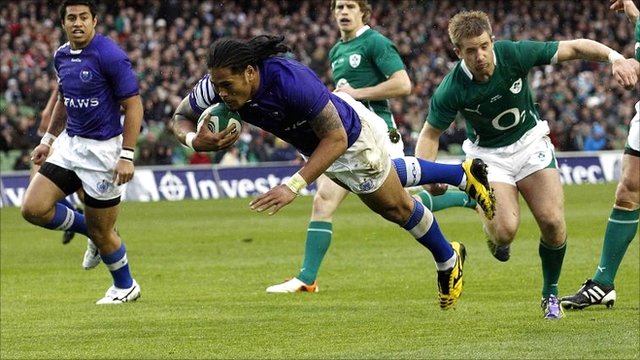
Players to watch: The entire team bristles with power, pace and no little footballing skills. For some reason, players who spend their Premiership careers aiming for contact become skilled steppers in their national shirt. like Ooooooooohh Seilala Mapasua – you won’t see pointless knock-ons like you do in Reading. Ooooooooohh Alesana Tuilagi made the WoC HEC Team of the Year, and deservedly so – he gave the Leinster defence more problems that any other player, except (bizarrely) Ooooooooohh James Downey. The era of Pacific packs being shunted around the place are long gone – formidable technicians who love the set piece have emerged, the best of which is Toulouse man-mountain and Iskanders fan Ooooooooohh Census Johnston.

Good tournament: With their RWC record against Wales (P2 W2), a quarter-final is the expectation in Samoa. If they get there, giving Australia a game is required.

Bad tournament: Not getting out of the group – it’s going to be doggedly competitive, but expectations have been raised by recent results.

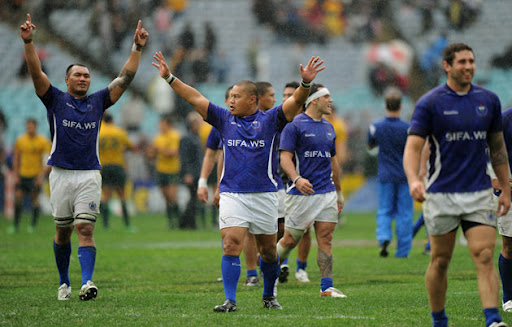
Prospects: Samoa are a proud rugby nation, and bring real personality and charm to the tournament. The innate physical strength and handling skills of the Samoans have been honed at Sevens level, and for a country with less people than Cork, they punch way above their weight.

The virtual wipeout in 2007 was a huge disappointment in Samoa, and being usurped by Fiji and Tonga even more so, especially given the quality of the squad. Post-2009, the IRB formally included Pacific teams in the international schedule, giving the islands a chance to re-connect with players in Europe, and build between tournaments. In Samoa’s case, this seemed to herald the development of a low-risk percentage game utterly different to tradition.

The tours to the Northern Hemisphere in 2009 and 2010 featured grinding defeats to Ireland, England, Scotland & Wales without the pyrotechnics and running from everywhere expected. A slight suspicion Samoa were developing a backbone of steel was confirmed in Sydney last month, when Australia were downed 32-23 in a game Samoa dominated, both at the breakdown and in line breaks – Matt Giteau certainly won’t forget it in a while, given he has been cast aside as a result.

The draw for this tournament is a little tricky for Samoa – while Wales haven’t beaten them in World Cups, South Africa have beaten them by 50 points in the last two editions, and Fiji have won 5 of the last 7 against Samoa, dating back to 2005. The team have had more time in camp than any previous tournament, and should show well, but the win over the Wallabies may have done more harm than good to their aspirations in New Zealand.

Verdict: They won’t get near the Boks, so it’s going to come down to a three team mini-league with Wales and Fiji. One win is probable, but not two – they are likely to be squeezed out in the group stage for the third tournament running, although they will certainly light it up, and might even make a tackle below the shoulders.