Five things we learned from this week’s Six Nations

Another week, another set of bogus predictions from the Whiff of Cordite boys.  I only hope all our loyal readers have been going to the bookies to lay exactly what we’ve been forecasting.  Wales to cut loose, Ireland to win a tight game and France to beat England.  Erm…

Ireland’s attack: now with 40% more penetration

Before the tournament, the one thing we asked – begged! – for was to see Ireland’s attack improve.  Credit to Deccie and Kiss; they have delivered.  Ireland look a threat with ball in hand now, and the flat, lateral play that characterised Ireland over the last couple of seasons has been largely dispatched – 13 tries in four games, and no fewer than two in any match, tells its own story.  It said a lot that even after a nervy, ponderous start, Ireland were willing to go to the corner with an early penalty, and take the game to the Scots.  It’s been a collective effort, but two players who deserve particular credit are Rob Kearney and Keith Earls.  Kearney’s counter-attacking has been a joy to watch, and Keith Earls has shown himself to be up to the job at 13.

Wales slam-in-waiting has echoes of Ireland in 2009

Wales have effectively won the Championship, barring a ridiculous set of results next week.  Their journey to the Grand Slam has been reminiscent of Ireland in 2009 – opening with an impressive flourish in the first match, before regressing a little with every game.  Ireland relied on an accurate kicking game, while Wales have fallen back on their power.  It’s almost as if they’ve bought into the press’ fawning over the size of their backline. No side that wins a Six Nations deserves to be sniffily treated, and less so one that wins a Grand Slam, as Wales surely will.  They are the best selected, best coached, and it would appear, fittest, team in the competition, but this is not a vintage championship.  Ireland, and indeed England, will not see them as especially superior, and are entitled to have some regrets.

Just how awesome is Richie Gray?

Very is the answer. Watching Scotland on Saturday was a little bit like watching Italy in recent times, when one player is just so much better than all his team-mates. Gray was physically and metaphorically head and shoulders above anyone else in a navy shirt, and indeed many in green. His try was a thing of beauty – Bob Kearney is getting some stick for buying Gray’s dummy, but Gray combined the dummy with a subtle change of angle and pace, and it was that, as much as anything, which did for Kearney. At times you felt he should step in at 10 to give Wee Greig a break – he most probably has the skills for it.

Gallic shrugs for all

It’s pretty clear France aren’t very engaged in this tournament. We thought they would stroll it, so mea culpas all round, but they just don’t seem too bothered. When they look like they might be embarrassing themselves, they step it up for a while (last quarter vs. Scotland, third quarter vs. Ireland, last 10 minutes vs. England), but generally aren’t too concerned. Why might this be? Well, PSA was roundly congratulated for his continuity, contrasting with Lievremont’s selections, but that has a flip side. Firstly, they were all physically and emotionally drained after the RWC. Secondly, the team’s key players are from Toulouse, Clermont and Biarritz – three teams with key months ahead, for differing reasons.

The rumour mill is already rife that Yachvili (and the FFR) would prefer to be with Biarritz to save them from relegation rather than devote time to Les Bleus. At the other end, Clermont are aiming for a unique double – and expect to see the Aurelien Rougerie we are used to and not the ponderous and disinterested passenger of the 6N when Les Jaunards pitch up in Lahndan in April. It’s not that the national jersey means nothing, it’s that these men can only give so much; and being a Basque, Catalan or Auvergnat is equally as important as being French.

And by the by, for a nation which professes to be in love with the drop goal, they’ve been utterly useless at them in this competition.

Lancaster’s investment in youth has paid off

England might have looked desperate at times, but they have done what they have needed to do, and, but for Mike Brown’s inability to fix a man, would be playing for the Championship this weekend. Lancaster tore up the tired old script and gave youth its head, and he has been rewarded. England are improving with every game, and it’s down to Owen Farrell (20), Manu Tuilagi (20), Ben Morgan (23), Alex Corbisiero (23), Chris Robshaw (23) and Brad Barritt (25). The youngsters are beginning to look comfortable in their surroundings, and England look in decent shape all of a sudden.

The test will of course come in adversity. Johnno tore up a pretty successful playbook after getting hockeyed by Ireland last year, and the result was a farcical RWC. England have their nemesis of recent times, a rejuvenated Ireland, up next, then a three test tour of South Africa at the end of a draining season. If their performances hold up, they don’t ship any heavy beatings, and they get two wins (or one if it comes in SA) from those four, England will have come through a very tough time to get to a pretty good place.

Six Nations: Round Four Preview

Wales v Italy

This is a no-brainer right? Right. Wales have won every game and are at home to an Italian side who have lost every game.

England showed the way for the rest of the world how to trouble Wales – tempt them into a bosh-fest. With Mike Philips at scrum half, there is every chance of dragging to a dogfight, tightening up space in the midfield, leaving Jamie Roberts too tempted by contact, and emasculating Davies, North and Halfpenny with no ball.

It’s a gameplan which might have appealed to Italy of two years ago but Novo Italia don’t do 10 man rugby any more – they toss the ball around with gay abandon and utter ineffectiveness. The lack of a fly-half worthy of the description is a major impediment, and they won’t come anywhere close to winning a game without one.

Only complacency is Wales’ enemy here, and there is a chance they could really go to town in the 4th quarter, like Ireland did, but they may empty the bench with Les Bleus in mind.

Verdict: Wales at a canter, by 20 points at least.

Ireland v Scotland

The Stade de Farce re-schedule and high-quality game means Scotland are coming into this game somewhat under the radar. All the talk has been about Tommy Bowe, Ireland’s aggressive defence then heroic resistance, followed by injuries to Paulie and Conor Murray. No-one has talked about Scotland, which is the way they will like it – from the soundbites coming from their camp, they seem confident they can win.

Scotland’s two Genuine Opensides (TM) will not only have Hook and McGurk drooling, but they will have Ireland worried – John Barclay did a serious job on them two years ago. In addition, Big Jim Hamilton and Slim Richie Gray will be licking their lips at the prospect of a lineout featuring no 4-jumper, or experienced caller.  Scotland’s lineout stats are the best in the tournament, and Ireland’s are the worst – and that was before O’Connell got injured.  The ball carrying ability of Healy, Best and the back-row is matched by Ford, Gray and Denton.

Ireland have a tradition under Deccie of having difficulty peaking for successive games. They will have in mind that England at Twickers will be draining, and may aim to go wide early and get some daylight on the scoreboard to facilitate third gear for the last quarter. The expansive approach will suit Scotland, and we fear inaccurate execution could let them grow into the game.

The Irish bench has been a real strength up to now, but we have been forced to start our best subs, and you can’t see McCarthy and O’Leary having the same impact that Ryan and Reddan have brought with them. Also, Radge’s corner kicking is effectively out of the equation given Paulie’s absence.

Verdict: We are intrigued by this Scottish team, and we think they will do someone over soon. Probably not Saturday though. Probably. Expect the Leinster half backs to drag Ireland over the line by less than a score.

France v England

Le Crunch.  Les Bleus v Les Rosbifs.  Le Marsaillaise.  Le Stade de France.  L’artiste dans le side of the pitch painting le picture.  Le vin rouge.  Le champagne rugby.  Les deux fairly ordinary teams based on championship form so far. 

France were much vaunted before the tournament began (including by us), but they have been fleeting, playing only in fits and starts.  They beat Italy without much of the ball, were decidedly fortunate to beat Scotland, and then were careless against Ireland, coughing up two turnover tries (one an intercept) and falling 11 points behind despite pretty much owning the football.  They’ve addressed things by replacing their stuttering halfbacks with the more prosaic talents of Beauxis and Julien Dupuy, and seem set to give it a bit of boot and bollock, as is PSAs wont.

This is the fixture where England tend to outperform, and they seem surprisingly chuffed with themselves after losing at home to Wales.  Lancaster has done a reasonable job so far but needs to learn how to use his bench i.e. don’t!  Under no circumstances should Dowson and an out-of-form Youngs have been introduced to disrupt England’s momentum.  They were unlucky in the end, and looked to have scored a potential equalising score at the death, but just two tries, both from chargedowns, in three games tells its own story.

Don’t expect a classic.

Verdict: We have France down for a narrow win here.  Expect the scores to rack up in multiples of three, but France may just have a single match-winning try in them.

And the Oscar for Best Supporting Actor goes to ……

Mick O’Driscoll!

Hardly a name that will be remembered by generations of Irish rugby fans. But it should be – Micko is a stalwart of the professional era, and reached a significant milestone on Saturday night when he earned his 200th cap for Munster, fittingly as captain, in his 12th season (he spent 2 years in Catalunya from 2003-05). The domestique of Irish rugby, he puts in the dirty minutes in an empty Rodney Parade and unquestioningly returns to the bench when Thomond Park fills up for big European nights. It’s Farrelly-esque to say that someone never gives less than 100% and never lets anyone down, but it is appropriate for Micko.

Micko’s professionalism and durability is remarkable, and he most certainly will be able to retire saying he made the most of his talent. It’s worth noting that Micko has never been first choice in his Munster career, being stuck behind Gaillimh, John Langford, Paulie, Stakhanov O’Callaghan and recently Donnacha Ryan, yet the majority of his 200 caps have been as a starter, which shows the trust that multiple coaches have put in Micko to lead the Celtic/Magners/Rabo league dirt trackers.

His best years were assuredly the 3 seasons from 2008-2011 where he led Munster to 2 league titles, consistently out-performed Stakhanov and famously played on an almost-but-not-quite night against New Zealand, when he was simply sensational, leading a team shorn of 10 internationals to within minutes of a stunning victory over a team containing Cory Jane, Joe Rokocoko, Kieran Read and, errrr, Thomas the Tank Engine’s brother (Ooooooohhh!!).

The moment that we will never forget is in 2009, when Munster lifted the Magners League trophy. The occasion was set to a desperately disappointing backdrop, being in the shadow of that defeat to Leinster, but Micko led the troops to yet another win, and, fittingly, was invited by provincial captain Paulie to lift the trophy. The class of the occasion was only matched by the Paul Derbyshire moment after the 2011 win.

Of the 23 players used by Ireland to win the 2009 Grand Slam, only 1 played zero minutes – Micko; yet you never would have worried if either of the second rows had pulled up injured (well, maybe a little if Paulie got hurt), such was his reliability. And if he owed his place to Mal O’Kelly’s errant timekeeping as much as his own qualities, well that’s not his lookout.  He did come off the bench in both HEC finals, but, unsurprisingly, and uncomplainingly, didn’t start either. For such a committed player in a notoriously dirty position, it’s also worth noting that his recent yellow card against Treviso was only his second ever and his first in 6 years, playing and thriving in a physical side not renowned for their discipline.

If only there was some term to convey the almost mythical, fabled, nature of his contribution… 

Mick O’Driscoll – we salute you!

Memo to Mike McCarthy: ‘Become O’Connell’

Lordy.  Talk about timing.  Obviously there’s never a good time for the premier lock in Europe to get injured, but coming just after Ireland appeared to get their season in motion, already without Brian O’Driscoll, captain and all round supremo Paul O’Connell is ruled out for the rest of the Six Nations through injury.  Just three games into his tenure, playing some of his best rugby ever, it’s desperately unlucky on a personal level, but worse still for Ireland.  Conor Murray will also miss the remainder of the campaign.  Again, it’s bad news, and awful for him personally, but it’s one position where we do have an able replacement, who was knocking hard for selection in any case.

Two vs. Four

Donnacha Ryan, already not so much knocking on the selectorial door as smashing his way through it, finally gets his chance, right?  Wrong!  Himself and Donncha O’Callaghan surely cannot be paired together, despite what Gerry says.  Both are front-jumpers (jumping at ‘2’) and neither has any real experience running the lineout.  The only time they were paired at Munster saw London Irish decimate the set piece and win the game.  In fact, if anything, the luckless Ryan is even more likely to miss out on a test start, because Deccie will baulk at having to change two second rows when he already has to change one.  Stakhanov O’Callaghan’s incredible fortune looks set to continue.

For this reason, the clamour to see Ulster’s impressive Dan Tuohy called up is misplaced (though he should be in the squad already).  He, like Ryan, is a front-jumping tighthead-lock, and it’s Muller that runs the lineout up north.

Ireland need a middle of the lineout jumper (jumping at ‘4’) who has experience calling the lineout. It’s one position we just don’t have that much depth.  Stalwart squad men Leo Cullen and Mick O’Driscoll are either injured and/or winding down towards retirement.  The only two options are Connacht’s Mike McCarthy and Leinster’s skyscraping Devin Toner.  Deccie has opted for McCarthy, and he’s a fine player enjoying another good season.  Athletic and full of aggression, all he has to do now is simply take the step up to becoming Paul O’Connell – easy!  He’ll have O’Callaghan alongside him, who could make anything up to eight tackles to help him out.

There’s always Biiiiiiiiiiiiiiiiiiiiiiiiiiiiig Bob Casey, who at least has the same physique as Big Jim Hamilton, but its hardly fair to deny Mike Ross the title of heaviest forward, and anyway, Big Bob struggles to get in to the London Samoa team these days.

Personally, we would have plumped for Big Dev, given his towering presence in the lineout, vastly improved performances this season, and how he has outperformed Richie Gray on both occasions when they went head-to-head against Glasgow in the HEC this year – but it’s much of a muchness, and every time we’ve seen McCarthy (not enough, perhaps) he has impressed us.  Plus, he’ll up the handsome quotient in the pack.

Verdict: in spite of the morning’s papers anticipating an all-Donn(a)cha, second row, we’re anticipating O’Callaghan and McCarthy starting together, Ryan once again on the bench.

Knock-on Effects .. for the Paddys and the Jocks

If Ryan’s chances of starting have taken a dent, Peter O’Mahony’s have increased.  POM is a light, tall fellow that’s easily thrown in the air, and has done well at the tail of Munster’s lineout this season.  Already probably deserving of a start in this game, Deccie may well see him as a good option to share the lineout burden.  It’s worth noting that Scotland have perhaps the best (maybe second to France) defensive lineout in the tournament, with Richie Gray a phenomenal ball-thief at the front, and Big Jim Hamilton adept in the middle.  A dedicated aerial specialist in the backrow would do no harm.

This would give the Irish pack a very French look, with 2 lumps in the second row and atheletic and talented lineout-enabled forwards in the backrow. Scotland picked 2 genuine opensides (TM) and nullified the French backrow well 2 weeks ago, but Robbo might be tempted to pick a lump at 6 (Kelly Brown and Alasdair strokosh would be ideal, but are injured) to really target the raw Irish lineout.

Verdict: Peter O’Mahony to start.  A somewhat out of form Sean O’Brien to miss out. Robbo to stick with 2 groundhogs, to the delight of Gormless George.


Oh Captain My Captain

The obvious choice here is Rory Best.  Already a longstanding member of the team-leaders panel, he emerged during the World Cup as a key figure in the pack (and a great player).  The only thing that might persuade Deccie to overlook him is the sheer weight already on his shoulders.  He will have the responsibility of throwing to an already struggling lineout now without its main man.  Maybe it’d be asking too much of him.  If that line of thinking did prevail, the armband would fall to one of Rob Kearney, Stephen Ferris or Jamie Heaslip.  Heaslip is usually the most talkative in huddles, but he rarely wears the armband at Leinster, and its unlikely he’ll wear it for Ireland.

Ferris and Kearney’s outstanding form alone makes them compelling, but its our old mate Bob would strikes us as the better option. ‘Twas a 10-cap Kearney who famously spoke up at the Enfield meeting, and by all accounts he is held in high regard by his colleagues.

In truth, any of the group would appear built for the role, and Deccie would do well to empower this group, and probably Sexton as well (like ROG, too cranky for the captaincy, but clearly a leader) with the role of leading the team.

Verdict: Best to captain, with Kearney his able lieutenant

Scrum Half

Little doubt that Reddan will now be the starting nine, but the call-up of Tomas O’Leary raised more than a few eyebrows.  Isaac Boss surely would have got the call, but is in New Zealand for personal reasons.  The folly of not calling up Paul Marshall in the first place has now come back to bite – this is classic stubborn Kidney.

Anyone who has watched Tomas and Paul in action this season will see two players at the opposite ends of the spectrum.  Marshall has been a key figure for Ulster, often coming off the bench, and has pushed his way into the starting line-up in recent weeks.  O’Leary meanwhile, had some reasonable cameos early on, but has reverted to his pre-World Cup form.  He is nowhere near operating at test level.  This is a terrible call by Kidney, which sees him, once again, playing favourites.

Ulster will be delighted that the Marshall-Pienaar axis can continue to develop; at least someone benefits from this deeply wrong-headed decision by Deccie.

Verdict: Unthinkably, O’Leary will be in an Irish matchday 22.  Wowsers.

Better When We’re Bitter

Well, that’s more like it, isn’t it?  It wasn’t quite enough to secure the win, but a draw in Paris was far better than what most of us expected.  It will ultimately go down as a disappointment, because Ireland put themselves in a position to win, but when it’s reviewed with a bit of context, it will go down as one of their better days under Kidney.  Here’s five things we learned from today’s game.

1. Bob Kearney and Stephen Ferris will be senior players on the Lions Tour

Amid all the Wales love this season and Lions-domination predictions, when for example Farmer Farrelly had 13 (thirteen!) Welshmen (and no Leinster players) on his Lions team, two of Ireland’s most important players have set extremely high standards.

Bob Kearney has always been the safest full-back in the air, but he has added really intelligent counter-attacking, line speed and leadership to his repertoire. Coming from a place where his replacement as Leinster fullback had inspired Leinster to a sparkling HEC, Bob has returned as a phenomenally good player. With Ben Foden off form, Little Leigh Halfpenny not a natural fullback and Stuey Hogg just out of nappies, Bob will go on his second Lions tour as a key player.

Meanwhile … Fez … what can we say. When Lionel Beauxis lined up what would have been the match winning drop today, we’re pretty sure he didn’t expect a forward to be the one on top of him, least of all Ireland’s huge enforcer and primary wrecking ball Stephen Ferris. Yet Fez was the man who batted him down. Fez! The quickest man over 10 metres in Ulster, the man’s power is simply incredible. He has twitch muscular strength of Samoan standard (Oooooooohhhh) yet has shown the softest hands in the Ireland team this series. The man is a freak and is the most Southern Hemisphere type player playing in the Six Nations. He’d walk into the New Zealand team, and will walk into the Lions team as well (sorry, Tom Croft).

Paul O’Connell, meanwhile, will be in the shake-up for the captaincy.  Age has not dimmed his ability to conjure up a sort of maniacal energy in the middle of the pack.

2. Les Kiss had a successful week at the office

Ireland’s line-speed in defence was vastly improved this week, and the benefit was reaped early and often.  In the first half hour in particular, Ireland had France in all sorts of trouble.  Any attempt they made to go wide was snaffled out with man-and-ball tackles from Ireland’s backrow and midfield.  Sexton and Ferris come in for particular credit here for their aggression and technique.  The choke tackle may be predictable at this stage, but it’s still effective and still wins turnovers.

3. Some semblance of a gameplan has emerged

Ireland didn’t have that much ball to play with, but they are starting to play with a bit more attacking shape.  We’re still not convinced management are getting enough out of the group of players in attack, but they are looking a lot more cohesive.  Sexton is having a lot of success running a line from very deep behind the ruck – almost to the point where you think he’s going to drop a goal (he mentioned in the Sunday Times that he’s seen Quade Cooper use it to great effect).  He’s comfortable carrying the ball towards the gainline and his ability to throw long, accurate passes takes out midfield blitz defenders.

4. Our strengths are our weaknesses and our weaknesses are our strengths

Ireland were arguably a functioning lineout away from winning the game.  Ireland’s centres stood up to the threat posed by France’s thoroughbreds and caused them some trouble themselves.  Come again?  Surely that’s the wrong way round.  Given the calibre of personnel running the lineout, it was alarmingly awful today, and wasn’t great against Italy either.  We would be surprised if it wasn’t fixed next week – it will need to be, because Scotland’s defensive lineout is perhaps the best in the Six Nations.

D’arcy and Earls were perceived as a massive weakness before the tournament, but they’ve been effective so far.  D’arcy’s still got quick feet that can make ground in traffic, even if he rarely makes clean breaks these days.  Earls, meanwhile, has been defensively good (one missed tackle and an admittedly crucial stupid fly hack that led to the French try aside) and the way he put Bowe through for the try… well you’d almost think he was a natural centre. 

5. Ireland need to back this up against Scotland

It’s not really something that you should dwell on, lest you get frustrated again, but Ireland’s annoying post-Grand Slam habit of one big performance a tournament is well-documented at this stage. Rubbish in the humdrum games, only to pull a huge performance out of the bag when nobody expects it.  The show in Paris yesterday was Ireland’s best against the Bleu Meanies in years, but can they follow it up against Scotland? With a six day turnaround, we can expect changes at 4, 7, 9 and possibly the introduction of Ferg somewhere in the 3/4 line to give some much-needed recovery to the front-liners – Donncha’s unseen work can be particularly wearying.

This should add a sense of urgency to Ireland because, let’s be honest, it’s primed for an ambush. You feel for Donnacha Ryan and Peter O’Mahony as they will be expected to hit the ground running. Yet Ryan will face one Richard James Gray, the most exciting second row talent to emerge in these islands since Alun Wyn Jones Paul O’Connell; and O’Mahony will be expected by goons like McGurk and Hook to produce a Brussouw-esque groundhog performance facing not one but two genuine opensides (we’ve checked and they’re genuine) in Ross Rennie and John Barclay. Good luck.

It’s going to be a tough day at the office, but lets not deflate this bubble too much!

Your coaches … give them to me, now

Having looked backwards in some detail at the Munster and Ulster progress in the last few years, it seems logical to have a look forward, especially in the context of the vacant hot-seats in Belfast and Limerick Cork Limerick. Both provinces will be linked with the usual posse of out-of-work-for-ages supremos e.g. John Kirwan, unavailable pipe-dreams e.g. Conor O’Shea and Desperate Dans e.g. Eddie.

But which job would a man want if both were offered? In fact, how do both jobs stack up? Lets get down and dirty and take a 3 year horizon.

Squad (Re-)Building

Ulster: Ulster’s squad has some tidy Saffers, a couple of Irish superstars and a cadre of young and hungry Irish talent. The squad should be expected to remain pretty settled in the medium term, and should form a good base to work with.   Tommy Bowe and Roger Wilson are coming back next season, which represents an endorsement of the province.  The major risk is the IRFU following through on the blame-the-foreigners act – Muller, Pienaar and Afoa would be virtually impossible to replace.  Delivering greater strength in depth is the first call of duty for a new coach; Ulster don’t have the calibre of reserves that Munster and Leinster can call upon.
Munster: A long to-do list beckons, in spite of the work done by McGahan in the last year. Has Rog three years left? Unlikely, even if he was that way inclined (which we doubt). How does one manage the transition from one of the greatest Irish fly halves in history to … er … Ian Keatley? Tough. First job on the list is pruning a bloated squad – the likes of Duncan Williams, Billy Holland and Scott Deasy are among the likely candidates for the chop / N18 to Galway.

Expectation Levels:

Ulster: High, but realistic. Ulster will demand some silverware in 3 years – a Rabo in year 1 or 2 followed by a HEC is the likely target. After two successive quarter-finals, a move into the Munster/Leinster league of being perennial knock-out stage merchants is the next step, as well as earning a home QF.

Munster: Sky-high, and not always realistic. Such is the level of success attained by the Liginds that the Munster faithful demand a HEC quarter-final and a challenge for the Rabo every year as a bare minimum.  Even if the new coach achieves that, they will not be considered a success without a HEC. We could poke fun by talking about honesty of effort and backs to the wall, but that guff belongs to Farrelly – it’s achievements that count in Thomond Park.

Set-up and Coaching:

Ulster: Still training at Newforge, and awaiting the sort of dedicated training centre and professional backup that Munster and Leinster enjoy at UL and UCD. The irony of Ireland’s leading sports science research mostly coming from Ulster (largely due to the GAA) is not lost on Humph etc. Ulster’s support staff and specialist coaches need beefing up, although a new coach may bring some of those.

Munster: Top facilities at UL, but half the squad is based in Cork – the bi-location is not ideal. The real problem for a prospective coach is, ironically given its where Munster have improved so markedly this season, the forwards coach (assuming here Axel is not the new head coach). Any new coach will have to accept Axel as forwards coach whether they want him or not – that said, he appears fit for purpose.

External Influence:

Ulster: Humph is a hands-on kind of guy, but one suspects that once the new coach and his team are in place, they will be left to it. Brian McLaughlin was left alone until Humph knew he was being replaced. The Ravenhill faithful will support the new coach unconditionally, for the first year at least, given he has the Humph seal of approval. There will be pressure to succeed, but there will not be interference. The rugby media in Ulster are generally rather tame, and without a record of success in a while, everything is still taken as a bonus.

Munster: Axel is regarded as the man in waiting by the suits and the fans (why do you think Ludd was only offered a 1 year deal?) – if things go badly, sections of the crowd will be looking for the coach’s head, and for Axel to step in. Is a top-name coach going to be interested in coming in for a couple of years, when he knows he’ll be moved on after that?  Now try transitioning Radge out of the team – the fans will only be on one side. The media can be fawning, but it’s conditional – if the Liginds like you, you’re in, otherwise, you’re out.

Conclusion:

It’s pretty obvious which job is more appealing to a big name coach, and it’s not the Munster one. In fact, it’s arguable that there are no positives for a non-Munster coach going in (other than the prestige of managing a great franchise), and that anyone with sense wouldn’t touch the job with a bargepole. That being as it is, the Munster hierarchy may be best off appointing Axel a year before they intended to and give him the best backs coach and coaching team they can get. Is it true Eddie is free (don’t snigger, he is an excellent technical backs coach)?

Up in Ulster, the possiblities are myriad – once you meet Humph’s criteria. One suspects Humph will want a young and hungry coach who will bring a new approach and ambition to the squad, like Joe Schmidt at Leinster. A big name like Wayne Smith may bring too much pressure and the risk of going off-message – better to get someone who Humph can trust and who will understand the task at hand. Someone like, say, Matt Sexton? As a former hooker, Sexton could take the forwards and bring in an experienced backs coach to help out. Someone like Eddie (we told you to stop sniggering).

Ludd McGahan Leaves A Mixed Legacy

Ludd McGahan’s departure from Munster won’t see too many tears shed among the Munster faithful.  He has never fully won over the fans in his time there, and for most it will be a case of ‘bring on the new era’.  His defenders will thank him for a good job, but won’t mind too much that he’s going deehn andah.

The truth of the matter is that McGahan’s task was a thankless, maybe even impossible one.  He took over Munster at a time when they were the dominant team in Europe, but had grown old together.  By his second season in charge, most of the core of his team were over the top of a pretty steep hill.  The only way was down.  Plus, he was taking over from Local Hero and Man of the People Declan Kidney.
To make matters worse, the previous management (of which he was a part, it must be said) had done little to manage succession.  Declan Kidney was hugely successful for Munster, but, as a coach, rarely looks too far beyond the next game.  As this superb dissection showed, during his time there, the academy produced next to no players of any quality.
Starter’s orders
The first few months of McGahan’s tenure went pretty swimmingly, though it’s hard to know how much to attribute to him, and how much was the continued good habits of a self-managing squad.  His first Heineken Cup game flirted with disaster, as Munster came within a whisker of losing at home to Montauban’s seconds, but they quickly got their act together, navigating the double header with Clermont Auvergne and dispatching Sale home and away.  They also nearly beat the All Blacks on a famous night in Thomond Park.  By now the Munster machine was purring.  They put together a stirring run of form in both competitions.  Even in the absence of their frontline players – traditionally a time for Munster to fold like a cheap suit – the likes of Mick O’Driscoll and Niall Ronan kept the show on the road.  The 22-5 beating of Leinster and the 43-9 crushing of the Ospreys in the quarter-final were arguably the very peak of their powers.  The Lions selection reflected their machine-like brilliance, and retaining the H-Cup appeared a formality.
Rise of the Blue Meanies Part I

Then something strange happened.  A thoroughly unfancied Leinster, fed on scraps of their horrendous press and the meeja’s Munster love-in, beat them 25-6 in the semi-final.  It was a game which effected a profound change on Irish rugby, and it took Tony McGahan and Munster a long time to recover. 

Over the next 21 months the rot set in.  The following year saw Munster win 9 out of 18 games in the Magners League, somehow squeezing into the newly minted semi-finals, where they were beaten by – not you again – Leinster in a game they never really threatened to win.  It was their third defeat of the season to their rivals – the first was a humiliating 30-0 thumping at a white-hot RDS, and the second a rare loss on their own Limerick patch.   In the Heineken Cup, Munster huffed and puffed, but made it to a semi-final, but  succumbed to a pretty ordinary Biarritz.  Sheer muscle was all Biarritz had, and Munster had nothing to stop it.
Goodbye Generation Ligind
Worse trouble was brewing: Generation Ligind were coming to the end of the road.  Marcus Horan and Denis Leamy’s powers were vastly reduced, John Hayes could give no more, Alan Quinlan was finished as a starter and Jirry Flannery was about to be ruined by injury.  Paul O’Connell was injured and Donncha O’Callaghan was never all that great in the first place.  Almost nothing had been done to ensure the next generation of would-be liginds was in place.
The chickens came home to roost in a disastrous campaign in 2010-2011.  Munster (and Ireland, crucially, for it tied Munster’s hand)  pinned their hopes on Tony Buckley to take over from John Hayes as the country’s premier only tighthead.  Buckley had come off the back of a successful summer tour, where he was one of few players to emerge with credit following an outstanding display of hard carrying and soft hands in New Plymouth.  But there was one problem: he couldn’t scrummage.  Munster lost carelessly to a poor London Irish side and, critically, to Ospreys, with Adam Jones winning the man of the match award without touching the football.  Faced with needing to win in Toulon, Munster went in to meltdown, turning in a shambolic performance and taking a thorough pounding.
Redemption!  Well, sort of
It looked grim for McGahan, and defeat at home to a young Harlequins side in the Amlin Cup was a nadir, but McGahan finally did what he should have done a long time ago and began to dispose of Generation Ligind.  In came some bright new things: Conor Murray, Peter O’Mahony, Simon Zebo and Donncha Ryan.  The Magners League was secured in style, beating newly crowned European kingpins Leinster. In this season’s Heineken Cup, Munster are set fair with a home quarter final and potential home semi-final.  Their maul and lineout are back to something like they used to be, and the scrum rejuvenated by some prime Saffa beef.  But you can’t help but feel McGahan is something of a punch-bag.  When things were going badly, he took the blame; now they’ve picked up, new forwards coach and all round ligind Axel Foley gets the credit.
The natives still aren’t happy though.  Despite winning six from six in the group stages, there’s a feeling that Munster haven’t played terribly well.  They no longer dominate opponents, and tend to eke out wins.  Increasingly, the twin totems of Radge and POC drag the team kicking and screaming to victory.  But, hey – it was ever thus.  Remember Munster’s peak in 2008 & 2009?  It wasn’t all barnstorming victories.  Those with short memories might have forgotten fortunate wins at home to Clermont and Montauban in 2009, and a decidedly shaky semi-final against an unheralded Saracens side in 2008.
Rise of the Blue Meanies Part II
We think it’s fair to conclude that while McGahan hasn’t brought the house down, he has done a decent job in difficult circumstances.  The ire with which he’s regarded in some parts of Munster perhaps has more to do with what’s happening in the blue corner than his own.  Munster fans probably wouldn’t mind a spell of being a bit rubbish, if it didn’t coincide so totally with Leinster’r rise, both on and off the pitch.  When McGahan took over Munster, Leinster were seen as a bit of a joke.  If you’d told fans of either province how the next three seasons would pan out back in 2008, nobody would have believed you.
Back to the Future
We’ll be taking a detailed look at what the Munster job entails later this week.  For whoever comes in to the role, by far the biggest task will be replacing Radge, for two reasons.  First, they have to find someone capable of being as good as him, and there aren’t too many 10s out there that are his equal.  Secondly, at some point they have to phase him out (succession and all that).  As Deccie has found with Ireland, this is harder than it looks.  He has managed part one, but part two is harder.  Any time you lose with Radge on the bench, you can bet his legion of admirers will castigate you for it.  Radge himself is not likely to hand over the shirt too readily, and isn’t shy of doing his bidding in publicIf Munster can manage that most onerous of tasks (they may need to look overseas), they look to just about have enough talent coming through elsewhere to keep them competitive for the medium term.

The Cup, the Plate and the Bowl

A non-vintage Six Nations campaign is heading for a straightforward blitz-tournmanent style finale.  In the last week, Wales and France will meet to decide the championship winners (The Cup).  England and Ireland will play for the Plate, or third place, and Italy and Scotland will tough it out for the Bowl (or to avoid the wooden spoon).

The Cup

Some of the mythology around the enormous Welsh backline was exposed this weekend.  Mike Phillips got overly involved in a fight with the English backrow, and Wales never looked like getting around England, so they just kept trying to go through them.  Getting into a boshfest with the Kings of Bosh is a risky game, and Wales were in a tight spot for much of the afternoon.  In the end they had just enough class to win out, with one of their smaller backs, reserve centre Scott Williams (weighing in at a puny 97kgs) coming up with a dash of brilliance to win it.  The Triple Crown is in the bag, and they are in a good position to deliver the slam, with France coming to Cardiff.

Here in Ireland we love nothing more than fawning over the French.  We’re spellbound by their pristine blue shirts, intimidated by their scrummaging power, awestruck by their handling skills, and swooning over Morgan Parra’s classic good looks.  But for all their Gallic genius, they rarely play all that well.  Truth is, they’re masters of just doing enough (unless they are playing New Zealand).  Not much has really changed under the new coach.  Sure, the selection is consistent, but the mentality is harder to shift.  France sleepwalked through the first 25 minutes here, and while their two tries were brilliant, there was no sustained greatness.  Trouble is, they are usually good for one outstanding performance a series.  One of Ireland, England or Wales will get it.

The Plate

England: played three, two tries, both chargedowns.  They’ve Strettle, Ashton and Foden in the back three, but they can’t service them with three midfielders with the distribution skills of combine harvesters.  Brad Barritt fought gamely again, and he’s not a bad player, but the lines of attack are too predictable.  For all that they probably scored a good try at the death, and after last week’s bottling exploits for his club, we’d all have loved to see the theatre of the last-kick wide conversion from Toby Flood to save a draw.  Two players who won’t enjoy looking at the tape this morning are Courtney Lawes, whose upright carrying style led directly to the Welsh try, and Mike Brown, who failed to fix his man with the non-try scoring pass to Strettle, and gave him an awful lot to do, when a stroll in was possible.

Declan Kidney is starting to get the hang of this newfangled ‘bench’ thing that other people keep banging on about it.  We’d heard of it ourselves, but weren’t quite sure what it was.  Turns out you can replace players during the game, sometimes even improving the side by bringing off a guy who’s tiring or not playing great and putting another player in his position.  Who knew?  All the talk this week will be that Ryan and Reddan should be starting in Paris (they won’t).  Both players are getting a raw deal.  Ryan is clearly the superior player at 4 to O’Callaghan, and is probably among Ireland’s best performers in the series so far, and it appears Reddan has never really earned the trust of the management.  He started their two best performances last year, and was influential in both, but found himself overlooked ever since.  Dropping a young player like Murray after two poor performances is not an easy call, but you feel that if Ireland are to have any – any! – chance of winning, Reddan needs to play.

The Bowl

Hard times for Scotland, who have improved out of sight this year, without getting the results to show for it.  Their handling and offloading was terrific yesterday.  Management are culpable for some outrageously bad team selections.  How was it that Hogg, Laidlaw and Blair had to wait until the third game in the series to take to the pitch together? Still, credit needs to go to them for making the changes. Scotland look like a team who might just win a few … if they can just win one.

It’s proving a difficult season for Italy, who haven’t really improved as much as people are letting on.  They were much more competitive last year, when they should have beaten Ireland and Wales, and toppled France.  The wooden spoon beckons methinks, as Scotland look to have too much for them – thouh they can be a different proposition in Rome.

It’s not been a classic series so far by any means, which had us wondering when there last was a classic Six Nations. Wales’ and Ireland’s grand slams in 2008 and 2009 were up against mediocre post-World Cup fields (France were off experimenting).  The best in recent times is probably 2007’s tournament, when strong France and Ireland sides went toe to toe, with France securing the Championship with the last play of the game against Scotland.  It’s been a while…

Follow the Money, Jimmy

As a brief follow-up to our Ulster piece earlier in the week, we thought we would add one point, and address one raised several times in follow-ups.

Addition: the Bob Paisley Rule

We here at Whiff of Cordite are followers of the Bob Paisley Rule – that is, change from a position of strength. Make your adjustments on your own terms and don’t let events overtake you (like when Bob Paisley jettisoned European Footballer of the Year Keggy Keegle for young Kenny Dalglish and improved his already all-conquering Liverpool side).
Humph has ticked this box at Ulster by recognising a potential weakness and addressing it pre-emptively. This stands in contrast to, say, Ludd at Munster. We’ll be posting on Ludd’s rather mixed legacy shortly, but he put off changing a successful Munster side until he was forced to i.e. after Toulon tore them a new one. His work since has been better, but he has never given the impression of having caught up with himself or being in control of the transition.

Follow-up: Mo’ Money, Mo’ Problems

More than once after the Ulster piece, people brought up money – how were Ulster able to develop so quickly, and sign such superstars? The Rory McIlroy blank cheque rumour came up, as did talk of some “private funding” – both nonsense. When considering Ulster budget, there are some important points to note:
  • Time lag. Contracts, by their very nature, are backward looking. Thats why Conor Murray, until very recently, was on an Academy contract, and the man he was keeping on the bench, Tomas O’Leary, was on a central one worth multiples of Murray’s. Murray’s contract was based on potential, O’Leary’s on a Lions selection in 2009. Ulster’s team, if you exclude centrally contracted and overseas players, are, for the most part, young and have no great record of success. Thus, they are cheaper. For example, Dan Tuohy is probably on a fraction of Donncha’s wage, yet has been much more effective this season.
  • Central Contracts. This is a particularly muddy issue that is deliberately shrouded in mystery.  The IRFU acts as paymaster for a number of Irish international players, but the hows and why’s of who has one and who doesn’t are puzzling in the extreme.  Brian O’Driscoll has one, of course, and so does Paul O’Connell.  No surprise there.  But so does Paddy Wallace.  Denis Leamy, Munster’s reserve flanker, recently signed a new one, in a piece of news which surprised everyone.  Sean O’Brien doesn’t have one.  Neither does Eoin Reddan.  The extent to which the IRFU directly pay the players from the various provinces is shrouded in mystery.
  • Hard currency. Leinster and Munster players get paid in Euros, but Ulster players get paid in sterling. The Belfast equivalent of a Dublin €100k salary is about £60k, that is €70k at current market rates. Ulster players generally cost less due to being in the sterling zone.
  • Imports. Now let’s address the overseas players issue. It’s fair to say Ulster’s cadre of foreigners are of a higher class than Leinster or Munster – Ulster have 3 genuine stars and a former Springbok captain. But do they cost much more and give Ulster an unfair advantage? Let’s have a look:
    • John Afoa: Afoa is a world class tight head prop. World class tight heads props are worth their (considerable) weight in gold, and are remunerated accordingly, with something akin to danger money added on. Afoa would be on a comparable wage to Mike Ross and BJ Botha
    • Johann Muller: Muller is a World Cup winning former Springbok captain. But he was never a starter in his Bok career or even a regular on the bench, and he is in his early 30s. As such, Muller is not a top dollar player – its conceivable he is paid less than Nathan Hines was
    • Pedrie Wannenburg. Ulster’s back row bosher is a regular try scorer and his offloads in the HEC this year were both delicious and unexpected. But in reality, he is a bit of a journeyman, and the Boshiership is crammed with players like Wannenburg. Suffice to say, he’s not going to be shooting the lights out in the payslip department
    • Simon Danielli: Is rubbish
    • Ruan Pienaar & Jared Payne: Are top class. Here is where Ulster have an advantage. Leinster and Munster each have one genuine superstar – Nacewa and Howlett. Ulster have 1.5 – Pienaar is one of the best players in the world, but Payne is not there yet. Payne wasn’t considered to be on the All Black radar despite his exploits with Auckland. Still, he has the potential to be explosive and could yet work out to be Ulster’s Isa Nacewa

So, Ulster players are younger and are thus on less money, and get paid in sterling. On the flip side, they have Jared Payne against, say, Matt Berquist or Save Tokula.

We don’t think the overall wage bill is any higher than Leinster or Munster.

Super Rugby – WoC Fantasy Contest

Our homework this spring is to know more about Super Rugby. It might be skillful and entertaining without much boshing, aimless kicking or inept gameplans, but that doesn’t mean that we in the Northern Hemisphere should snear at it.

So we are setting up a Fantasy League on Fox Sports excellent flamin’ website, so log in, set up a team and join our league (code 1890-6547).

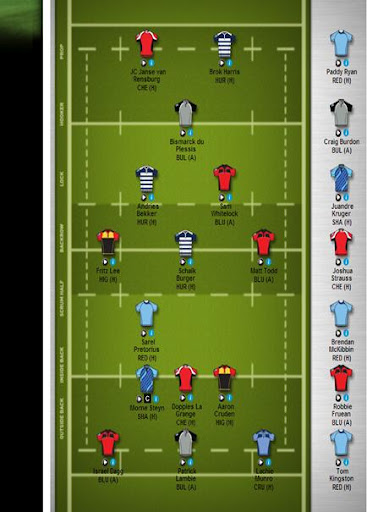
In the interests of full disclosure, Egg Chasers team is below, and its heavily long South Africans for a reason I’m not really clear on: