Self-Loathing Tendencies

Nobody does heartbreak like the Irish.  We are still SO cut up about Sunday – whatever about BNZ’s ruthlessness at the endgame, this team were brilliant and BNZ were blessed, utterly blessed. And the manner of the defeat – having it snatched from your grasp like that – is the worst bit. Sure, it was a (relatively) meaningless November international, but BNZ desperately wanted to win to preserve their oh-so-perfect year, and we did everything but win.

We aren’t sure we have emerged from the zombie-like PTSD, but we’ve got enough perspective to work out how much it hurts … relative to other heartache Ireland have put us through in recent years.  The list is long, and this is just the tip of the iceberg.

  1. Argentina, World Cup 2007 This was horrendous. An awful tournament came to a jarring halt – toyed with by a team who hated us, and enjoyed their humiliation of us immensely. A complete non-performance that capped a month of them. The team were whacked and bagged so comprehensively, we felt like a boxer reeling from a barrage of punches. Expectations were high, disappointment even higher. Palla was there, having enjoyed a barmy Peak Of The Celtic Tiger blowout in Paris, drinking champagne from shoes and making our way home most ‘nights’ with the morning commuters.  That night though, barely able to speak, we went back to our mediocre lodgings and had an early night.
  2. BNZ, 2013 Can’t talk about it yet
  3. France, 2007 Palla sat in Croke Park for a good 30 minutes after the game, unable to move. To have come so close against our closest rivals for the championship, but to give it up when so much needed to go France’s way for that try to count – soul-destroying. But Vincent Clerc was a great player, the France team was excellent, and we nearly won despite being shorn of POC and BOD. Sure, it robbed us of a Grand Slam, but only in retrospect. Plus we took out England in spectacular fashion on the back of the pain
  4. Argentina, 1999 It wasn’t so much losing, as the manner of it. A rubbish game, and an utter lack of guile in the final minutes – the world had moved on and we were being left behind. The future looked bleak, coming on the back of a decade of defeats, and one worried about when we would ever see Ireland back at the top table. Simply awful.
  5. Australia, 1991 We weren’t old enough to appreciate the full pain of this one, but that’s not to say it wasn’t painful. There was a weird inevitability about it.  The scenes in Lansdowne Road were hairs on the back of the neck stuff, but this Ireland team couldn’t finish a packet of crisps.  Australia didn’t have long to score, but you just had the feeling they would.
  6. Wales, 2011 Ireland’s performances in the pool stages in New Zealand had blown the tournament wide open.  The team were playing brilliantly and clearly enjoying themselves. A path to the final had opened up with only Northern Hemisphere teams blocking the route. We thought Ireland had changed. But they hadn’t. It was like being stood up at a date with the girl of your dreams.  For Palla it was the most surreal of the lot.  Having been down in New Zealand and watched the pool games amid an ever-increasing feel-good factor, suddenly he was getting up at 8am to watch Ireland lose.  Had the previous four weeks been a weird dream?
  7. England, 2008 Forget the context of Eddie’s regime collapsing. Forget the lesson in game management Ireland got from Danny Cipriani. Forget the English joy at our hubris from 2007 being thrown back in our faces. And remember this – we lost by 23 points … and Lesley Vainikolo was playing for the team that beat us. Shameful.

Je Ne Regrette Rien… Except Maybe These

The IRFU pulled the plug on the Declan Kidney era yesterday, announcing that he would not be offered a new contract.  It draws a line under another managerial tenure that has been a distinctly mixed bag.  Kidney’s career as head coach can neatly be split into two bundles, one succesful, one not; the unbeaten claendar year in 2009, and everything since then.  We’ll always have the memories of Ireland’s long overdue Grand Slam, but beyond that, it was a long, slow and often painful slide towards the fiasco that was this year’s Six Nations.  Everyone knew the end was coming, except Deccie himself it seems, and the only surprise was that he didn’t resign and instead made the IRFU effectively sack him.

Sports coaches on the brink, movie stars in decline, those in power falling from grace: they all have a habit of telling you they wouldn’t change a thing in spite of the grisly endgame. We don’t know, but Kidney will probably never publicly admit to having made grievous errors in his tenure as Ireland head coach, but here are five mistakes that, privately at least, he’ll probably rue.

Paris, 2010. Paddy Wallace’s selection on the bench to cover the outside backs

Following Ireland’s stellar 2009 calendar year, the notoriously hard trip to Paris was the biggest obstacle in their bid to repeat the trick with another Grand Slam. The team was largely unchanged, but the bench had an odd look to it with the rapidly emerging Johnny Sexton now in the 22 as reserve fly-half, but Paddy Wallace retained as cover for the back division.

Ireland started brightly, causing the French worries with Gordon D’arcy looking threatening; indeed he was very unlucky not to score following a clean break, when his chip over the full back bounced oddly and out of harm’s way.  But things took a turn for the worse when Rob Kearney went off injured.  With Paddy Wallace the only available cover in reserve, a lot of shuffling around was required.  Earls moved to full-back, Wallace came on at 12 and D’arcy was shifted to the wing, where he was notably less effective.  Ireland’s attack was blunted and the French moved through the gears, eventually running out impressive 33-10 winners.

Symptomatic of wider malaise?  Yes.  In truth, Kidney never really developed the art of using his bench.  As coach of Munster he generally kept changes to a minimum; in the 2008 Heineken Cup final he brought on only two replacements.  As test rugby became increasingly a 22-man (and then 23-man) sport, Kidney struggled to adapt.  The bizarre (non) use of Sean Cronin as reserve hooker exemplified this.

November 2010. Failure to select Mike Ross and Sean O’Brien

Following a ho-hum Six Nations in 2010, and with the World Cup on the radar, the November test series looked like a chance for Kidney to refresh his team, which was now showing signs of rust. The tour of Australia and New Zealand in June was notable for the number of players selected – but most did well, and the team were far more competitive than expected given the injury carnage – four second-half tries while a man down against BNZ, then pushing Australia to the last bell meant the tour seemed like it would be something that could be built upon.

South Africa were Ireland’s first opponents in November, but Kidney elected to remain more or less true to his Grand Slammers of 2009, albeit with Sexton and Reddan selected at half-back.  Over the course of the four matches, Kidney stuck rigidly to his template.  It meant that Sean O’Brien – explosive with ball-in-hand for Leinster in the weeks leading up to the series – was limited to one start, in the Samoa game, and couldn’t even get ahead of an out-of-form Denis Leamy to win a place on the bench for the real matches.

There was also an urgent need to promote new tightheads, given that John Hayes was now in steep decline.  Kidney pinned his hopes on Tony Buckley – occasionally destructive in the loose, but a poor scrummager and with a tendency towards laziness – and when Buckley got injured looked to Tom Court and John Hayes to back him up.  It looked a strange decision not to even consider Leinster’s Mike Ross, now a mainstay of the province’s first team and a technician in the set piece, and so it proved.  Ross saw not one minute of action, but as the season unfolded and Buckley’s lack of technique proved hugely expensive for Munster, Ross found himself first-and-only-choice for the following Six Nations, while O’Brien was also belatedly promoted to the team.  The two players went from outside the match-day squad to lynchpins, more by accident than design.  It showed a lack of foresight, canny management and joined-up thinking.

Symptomatic of a wider malaise?  Too often Kidney seemed unwilling to promote talented players ahead of ‘his boys’, even when it looked obvious to outsiders that the incumbent was woefully inferior.  The debacle repeated itself with O’Callaghan / Ryan in 2012 and ROG / Jackson / Madigan in 2013.

RWC 2011; selection of ROG vs. Wales

In the 2011 World Cup, Ireland stood on the cusp of greatness.  They had memorably seen off Australia and dismantled a poor Italy side with little fuss.  The tournament had opened up for them, with Northern hemisphere teams lying in wait in the quarter- and semi finals.  There was just one slight problem.  Their premier fly-half, Johnny Sexton, had a dose of the wobbles with placed ball.  It led Kidney to dial 021-4-RADGE for the Italy game, and the Munster fly-half performed consummately.

The question was whether to stick with ROG for the quarter-final, against an eye-catchingly in-form Wales.  The Welsh team’s blitz defence and unwavering determination to bully O’Gara had made things difficult for ROG in the recent past.  Many expected Kidney to revert to the team which had beaten Australia, with Reddan and Sexton dictating attack from 9 and 10.  But he stuck with O’Gara and Murray.  Wales read Ireland perfectly, ankle-chopping their marauding flankers and isolating ROG, cutting him off from his backline with a super-fast blitz defence.  The chance of a lifetime was lost, and if Kidney could wind back the clock to have one game again, we suspect it would be this one.

Symptomatic of a wider malaise?  Yes, an inability to pick correct houres for courses.  In all of Deccie’s tenure, we never got the impression he picked teams with specific opposition traits in mind.  His first XV was his first XV no matter what.  ROG was the man to keep a mediocre Italy at arm’s reach, but his selection was exactly what the Welsh team would have wanted to see.  Kidney had to pick Johnny Sexton and hope his kicking woes were behind him (he slotted a touchline conversion at the end of the Italy match, so they may well have been).

Post RWC: failure to replace Gaffney as attack coach

If Ireland’s world cup was anti-climactic, at least it wasn’t an abject failure, and Ireland had done much right, not least in tactically outmanoeuvring the Aussies and their choke-tackle-led defence.  But in the aftermath of the loss against Wales, it was largely agreed upon that Ireland were lacking dynamism when it came to ball-in-hand attack, where Plans A, B and C consisted of getting Ferris and O’Brien to truck the ball up.  Their attack coach, Alan Gaffney, whose sum contribution appeared to be the Randwick Loop, was finishing up in any case and it looked like the perfect opportunity to bring in a new voice, with new ideas and given a remit to get Ireland’s attacking game up to speed.

Instead, management went down the bizarre route of placing a committee in charge of attack, with Kiss, Deccie himself and Mark Tainton, the kicking coach, taking over the role.  If it looked a bit like a patched up non-solution, then that’s exactly what it was.  The result was as you might expect – Ireland continued to look laboured with ball in hand.  The 2012 Six Nations was another failure, finishing off with the Twickenham Debacle.  Brian O’Driscoll was suitably concerned to air his grievances in public, saying the players didn’t really know who was in charge of Ireland’s attack, in what was a rare shot across the bows from the captain.

Symptomatic of a wider malaise? perhaps Kidney’s greatest failing was his failure to deliver a recognisable attacking gameplan for Ireland.  His grand slam was won by strangling the life out of opponents and an aggressive kick and chasing game, but once the breakdown rules (sorry, interpretations) were changed to encourage a more ball-in-hand style of play, he never successfully adapted.  Ireland’s style seemed to vary wildly from match to match, at times making them look uncoached.  Every so often they would appear to click into shape, only to revert to mush in the following match.  Ultimately, Kidney’s Ireland lacked identity, a way of playing the game that they owned.

The Entire 2013 Six Nations

2013’s was the last Six Nations of Deccie’s contract, and in effect he was playing for a new deal.  The superb performance in beating Argentina had set Ireland up nicely, but from first to last the campaign was a shambles in a way that nobody could predict.  Sure, injuries didn’t help, but Kidney and his team had a horrendous championship.  The trouble began with the appointment of a new captain, Jamie Heaslip.  It looked a positive step, designed to cash in on the momentum generated in November, but was dreadfully handled, not least when it emerged how upset BOD was at having been demoted.

Despite a morale-boosting and impressive win against Wales, things quickly unravelled, sparked by injury to Johnny Sexton.  So abysmal was ROG’s performance as reserve that Kidney elected to throw Paddy Jackson into the starting team for the next game, against Scotland.  Trouble is, Jackson hadn’t place-kicked in four weeks and management had made a blunder in not ensuring he got some practice the week before against Zebre.  In the event, Jackson missed three kicks and Ireland lost.

It got to the stage where every press release issued by management led to backtracking the following day.  When ROG was omitted from the squad (justifiably) for the following game, the next 48 hours were spent assuring the nation that he wasn’t being retired, when clearly he was. Sexton was named against Italy, only to be ruled out for a month shortly after the presser had concluded. The entire camp seemed to be imploding.

The final blow came in Rome, where Italy won 22-15 against an Ireland team that looked rudderless and without any sort of gameplan – had Italy been any less nervous, they could have won by 30.  The only player to try and make things happen was Ian Madigan, whom management had studiously ignored for the previous 12 months.  It just about said it all.

Symptomatic of: failure to plan for future when ROG was visibly fading.  Anyone with eyes in their head could see that ROG had been in decline since the 2011 World Cup, but management persisted in putting off the day they break Jackson or Madigan into the squad.  It resulted in Ireland having two fly halves with a single cap between them in the squad for the game against France. Had the re-build been conducted in the 2012 Six Nations, summer tour or November series, Ireland might have developed to the point where they could easily have managed the injuries sustained – postponing it meant blooding debutants left, right and centre.

Why Hasn’t Kidney Resigned?

In the wake of Ireland’s loss against Italy, we tweeted that Declan Kidney should have the good grace to resign later in the week. It wasn’t just hot headedness in the aftermath of a painful defeat, and we stand over it. But it hasn’t happened. Kidney’s initial reaction made it seem like it was going to – he said he’d have to think about whether he even wanted a contract, but since then he’s been defiant.  He followed that up by saying he knows what he can bring to the role, and has dug teams out of holes before.  We won’t go into the myriad daft reasons being invented by his media champions in an attempt to cobble together an argument for Kidney to be kept on, but let’s just say that anyone who thinks ‘corporate knowledge’ of a group of players is enough of a reason to give out a new contract is teetering on delusional.

Kidney appears to be angling for a new contract and is not going to go down without a fight.  It’s not exactly the most dignified end to his Irish managerial career, and by all accounts it will be the end.  By sticking around and looking for a new deal, he’s putting out a message that this year’s Six Nations campaign (fifth place, one win, one draw, three losses) is an acceptable performance, when it quite obviously is not.  While one can have sympathy with Kidney over the mounting injury toll on his squad, taking a step back and looking at how the series unfolded, it is clear that it was run in a most shambolic manner.  Almost every press release issued from camp seemed to result in 48 subsequent hours of backtracking, while the oversight in failing to ensure Jackson took placed kicks in the week before his test debut against Scotland amounts to a seroius blunder and with every passing week, the non-selection of Ian Madigan appears to look more and more ridiculous.  Even without such obvious catastrophes, there appears to be a malaise within the squad, and some fresh ideas and a new voice are needed.

There’s something terribly Irish and parochial about hanging around in your post long after your usefulness has expired.  How often have we seen our TD’s and councillors clinging to power when they should have resigned?  Ireland’s previous coach, Eddie O’Sullivan, is generally derided as an aloof, egotistical character, but he did at least recognise when his number was up.  He resigned within no more than four days of his last Six Nations match, a hammering in Twickenham against a Cipriani-inspired England.  He had three years remaining on his contract, but he knew he’d made a mess of things at the end, and it was time for a change, and he fell on his sword.  Kidney is not even in that position – he’s looking for a new contract as some sort of endorsement of recent performances.

O’Sullivan had injury troubles in his final campaign, and some bad luck too, but there was no media clamour looking to line up the excuses for him.  He lost Gordon D’arcy in his first match, and in the final game in Twickenham he had a patched-up backline on the field, with Shane Horgan and Andrew Trimble playing the majority of the match in the centre, and a very green Luke Fitzgerald and Rob Kearney, along with a newly recalled Tommy Bowe in the back three.  Against Wales, when Ireland lost narrowly, Shane Horgan was inches from scoring a try but couldn’t quite stretch out his arm far enough to score.  Ireland finished the series with two wins, one more than Kidney achieved this time around.  The game was up and the coach quit.  Kidney should do the same.

All That Glisters Is Not Gold

When one observes the state of the Irish international rugby team, one gets most depressed. One win in the tournament harks back to the late nineties, when we were genuinely rubbish. But are we as bad as results say we are? We don’t think we are over-reaching ourselves to say that, no, we aren’t. The players that make up the Ireland team do ok in their day jobs, for one. The reasons put forth for why we are so bad are as follows:

  • The coaching ticket don’t know what they are doing. This is the position most people with two eyes and a functioning brain hold. Conservative selection up to November 2012, before apparently flicking a switch and picking everyone in Ireland for the 2013 Six Nations, is one reason. Confusing roles for the support staff is another – what does Les Kiss do, for example? Does it actually change every series, or is that just his title. Does Mark Tainton have a role in our kicking game? If so, why has he held on to his job for so long when it is so bad? This is an entire other debate, but it appears that it will soon be over – Deccie might not be of a mind for falling on his sword, but someone will administer the last rites
  • We keep getting injuries. This is true – but it’s a mitigating factor, not a reason for our failure. At various stages of the Six Nations, we were missing six Lions (Tommy Bowe, Stephen Ferris, Paul O’Connell, Gordon D’Arcy, Keith Earls, Luke Fitzgerald) and the presumed Lions outhalf for this years tour. It’s unfortunate, for sure, but Earls and Fitzgerald aren’t first choice, Luke Marshall deputized ably for Dorce, and, while it would have been nice to have Bowe available, Craig Gilroy had a decent tournament. On the flip side, Ferris’ physicality, and O’Connell’s leadership up-front were not adequately replaced – still, an international side should be able to wear the loss of two front-liners, no matter who they are. And anyway, don’t we have a Player Management System for this very purpose?
  • We had no luck. If Keith Earls had seen Drico, we would have been too far ahead of Scotland to lose! If we had just held on for ten more minutes, we would have beaten France! We had a flanker on the wing for 40 minutes against Italy! Yes, but he didn’t because he backed himself in a low percentage play (player fail), we didn’t because our bench made no impact (coaching fail) and Peter O’Mahony’s defensive positioning wasn’t exploited once (Italian coaching fail), and sure he spends most of his time on the wing anyway (insert smiley face icon). As Gary Player said, the more I practice, the luckier I get, and we don’t appear to practice, or have a proper plan to put into practice at least.
  • Referees hate us. This canard – the Irish coaching ticket are very fond of this one, as are their cheerleaders in the meeja. Gerry Thornley said after the 2011 Six Nations,  Messrs Poite, Pearson, Owen and Kaplan (with the, eh, help of Allan) gave them a raw deal. Really, in all our games but one, the referee was biased against us? Axel Foley was barely in the job two minutes when he was moaning about the men in the middle. It’s a road to nowhere, and it’s untrue at any rate – sure, you get bad decisions from time to time, but they will average out, and if your team commits more offences than the opposition, the penalty count is likely to be against them
  • There are shadowy people in the IRFU telling Deccie who to pick. Riiiiiiiiiiiiight Frankie. Do they meet in badly-lit underground carparks? And you are sure this isn’t just paranoid nonsense to mask the fact that you can’t admit that Deccie can be wrong, AND Ronan O’Gara is out of form? Oh, you are speculating – well, how about you speculate somewhere else instead of trying to masquerade as an expert
  • The end of the Golden Generation. Now, this is what we came here for. Let us examine this one in some more depth

The ‘Golden Generation’ in Irish rugby terms is generally taken to refer to the team which won three Triple Crowns in four years from 2004-2007, then collapsed spectacularly at the World Cup that year. The team was still mostly intact for the Grand Slam in 2009, but there was an infusion of new blood through the likes of Jamie Heaslip, Stephen Ferris, Tomas O’Leary, Rob Kearney, Luke Fitzgerald and Tommy Bowe.

The contention is that the retirement of the ‘Golden Generation’, one-by-one, and their replacement by inadequate players following up is one of the reasons that we aren’t as competitive as we were back in their heyday.

To digress for a moment, our first hearing of the term ‘Golden Generation’ was in reference to the Portuguese soccer team that won World Youth Cups in 1989 and 1991 – this was the team of Rui Costa, Luis Figo and Paulo Sousa. At senior level, the team rarely bothered the scorer, a semi-final at Euro 2000 being the pinnacle of their achievement. It was in fact the next generation, spear-headed by Cristiano Ronaldo, that has brought Portugal to the level of consistent semi-finalists in international football (2006, 2008, 2012). The silver medal at Euro 2004 was mostly the younger team, but with Figo and Costa playing prominent roles in the team and squad.

So the Portuguese ‘Golden Generation’ actually achieved less than their ungarlanded successors. Interesting. The term ‘Golden Generation’ seems to imply something once-off, something that can never be repeated and must be milked for all its worth. After all, the supply of gold is fixed … oh wait, it isn’t!

So let us examine the first-choice Ireland team of 2007 versus the first-choice team of 2013. We will assume there are no injuries, and then examine the benches.

Front Row:

Marcus Horan, Jirry Flannery, John Hayes vs Cian Healy, Rory Best, Mike Ross. The Ireland scrum always seems to be on the point of collapse, and Hayes and Ross have toiled manfully at the coalface to prevent it for the best part of 13 years. Ross is more powerful and destructive, so we’re taking him. On the loosehead side, Healy on form is one of the best in Europe, whereas Horan was a wily operator who got by more on street smarts than talent. At hooker, it’s a great problem to have – Jirry was a better thrower and more dynamic in open play, whereas Besty is an excellent groundhog and a better scrummager. Verdict: 2013 props, and either hooker

Second Row:

Paul O’Connell, Donncha O’Callaghan vs Paul O’Connell, Donnacha Ryan. No contest here – Ryan has a higher ceiling than DOC did, but his level now is rather similar to DOC in 2007. However, O’Connell is injury-ravaged and battling to get his career back on track now, whereas he was close to the peak of his powers in 2007. Verdict: Paul O’Connell (2007) with either of the others

Back Row:

Simon Easterby, David Wallace, Denis Leamy vs Stephen Ferris (if fit) / Peter O’Mahony, Sean O’Brien, Jamie Heaslip. At the blindside, Fez is one of the few world-class players in Ireland, but is frequently injured and appears to be off to Japan in any case.  Peter O’Mahony is the chosen man at 6 in his absence.  Ferris is far and away the pick of the bunch, and we’d be more or less neutral between O’Mahony and Easterby; one a grafter, the other a footballer, both good in the lineout .  Neither of the sevens are classic opensides (plus ca change), but both are excellent players – we would be content to have either in our backrow. At the back of the scrum, we’d have Heaslip – Leamy had the skills for 8, but was really a converted blindside, Heaslip is a Test Lion, albeit one used as a ruck scrapper by Ireland. Verdict: Ferris if fit, otherwise neutral; either of the sevens, Heaslip

Half-backs:

Peter Stringer, Ronan O’Gara vs Conor Murray, Johnny Sexton. Good choice to have here, and four very different players. Stringer was the passer supreme, whereas Murray is in the breaking and game managing mould. Having said that, Strings most memorable moments (Biarritz 2006, Scotland 2009) cam from breaks, and Murray is a better passer than he is generally given credit for. We’d go for Murray on the basis that he offers a little more variety to the game. At outhalf, you have a Ligind versus a money-grabbing traitor. Or a one-dimensional boot merchant who can’t defence versus a triple Heineken Cup-winning best outhalf in Europe. ROG of 2007 or Sexton of 2013? We’d take either (which will prevent this piece being entirely about this choice as well). Verdict: Murray, either of the tens

Centre:

Gordon D’Arcy, Brian O’Driscoll vs Gordon D’Arcy, Brian O’Driscoll. One of the best centre partnerships of all-time. It’s pretty obvious that having them in their late 20s at their best is preferable to now, with a nod to the fact that the output, particularly of O’Driscoll, is still at a high level. Verdict: 2007 vintage

Back three:

Denis Hickie, Shane Horgan, Girvan Dempsey vs Simon Zebo, Tommy Bowe, Rob Kearney. Not much to choose between those two lineups, with the exception of left wing, where Hickie, along with Simon Geoghegan, was our best and most natural wing in our lifetime. On the right, Horgan was a supreme catcher and finisher, but Bowe hits the line exceptionally well, and brings just a shade more class.  When he is missing, Ireland’s try count inevitably declines. Both are good defenders and great fellows, but only Bowe is a nailed-on Lion when fully fit. At full-back, Dempsey is the better defender, and Kearney uses his boot more effectively in attack. Again, Kearney on form is a Lions class player, whereas Dempsey, for all his qualities, never quite convinced he was better than Geordan Murphy, his backup. Verdict: Hickie, Bowe, Kearney

Bench:

Simon Best, Rory Best, Malcolm O’Kelly, Neil Best, Isaac Boss, Paddy Wallace, Geordan Murphy vs Tom Court, Sean Cronin, Mike McCarthy, Peter O’Mahony / Chris Henry, Eoin Reddan, Paddy Jackson, Luke Fitzgerald / Keith Earls / Craig Gilroy / Fergus McFadden. Neither bench would be familiar with coming on to play a specific role, with both teams heavily dependent on the first XV. We have chosen Tom Court to cover both sides of the scrum to make the benches comparable, and hav gone with the management team’s preference for Paddy Jackson over Ian Madaigan as reserve out half, whatever the wisdom of it. Neither bench would especially fill one with confidence – the standouts would be Rory Best, Mal O’Kelly, Geordan Murphy (2007) and the myriad of back three players from the 2013 team. So, 2007 looks slightly higher in quality, with the caveat that Neil Best is nowhere near international class, and Paddy Wallace is not an outhalf. Verdict: Hobson’s Choice really, but 2007 by a nose.

Overall then, player for player, there’s little to choose between the groups of players.  It’s very hard to make the argument that the ‘Golden Generation’ of 2007 is markedly superior to the current group of players. Great players have retired, for sure, – 2007 is six years ago at this stage, and it would be strange if they hadn’t – but the replacements are players of arguably just as high a standard in almost all cases.  The so-called ‘Golden Generation’ were undoubtedly golden compared to what went before, but that’s not to say the next generation of players – no doubt inspired by seeing the likes of O’Driscoll, O’Connell and O’Gara in their youth – couldn’t be just as good.  There is no reason to assume they were a one off, and that Ireland couldn’t continue to produce talented footballers.  There is no lack of good players available to national team coaches, and a talent drain due to retirements cannot excuse recent performances.

Not so golden after all then, but headlines can’t make use of the term ‘Base Metal Generation’ or just ‘Generation’ as much can they?

Second Half Syndrome

An odd and recurring feature of Ireland’s play in recent times is the late-game collapse whereby the team just runs out of puff around the hour mark and cannot be revived. Sure, no joined-up 23-man gameplan has something to do with it, but it’s still intriguing, and worth looking at.

The first question to ask is, are Ireland’s players simply unfit, in what would be a throwback to the old days when beer-soaked Irishmen could not sustain a test match beyond the 60th minute.  But it doesn’t hold up.

Examining the provinces, Munster have virtually trademarked late-game revivals, and the tear-soaked endgames where Northampton, Castres, London Irish, Embra (to name but a few in recent years) have succumbed to the will of the men in red in the red zone are classic examples. Leinster in recent seasons have at times slowed up in second halves, but usually as a result of being out of sight by half time (Bath, Cardiff last season), and when the going is tough, are usually adroit at seeing out the final quarter. Ulster have less of a record, but the defensive shift in Thomond Park stands out, and they will (assuredly) have more as time goes on.

So the constituent players frequently grow in stature in the fourth quarter, yet the national collective wilt – what does that tell you? The most obvious conclusion is that the provincial coaches are more productive with their use of their bench – frequently selecting players for their off the bench impact and using them intelligently.

Leinster have specialist high-impact reserves in Heinke van der Merwe, Sean Cronin and Isaac Boss, and they form a crucial part of the gameplan, and the likes of Paul Marshall has frequently given Ulster pep off the bench.  Ireland have struggled with this aspect of the game under both Eddie O’Sullivan and Declan Kidney, and substitution strategy (such as it is) seems perfunctory and forced rather than planned.  The idea of an entire front row playing 80 full minutes in the modern era would be guffawed out of town by France, England or South Africa, but Ireland are still at it.

We crunched the numbers from the beginning of 2011 against in full Tests (i.e. not USA, Russia or the A game vs Fiji), and it’s stark:

  • In 15 Six Nations games, Ireland’s first half record is W11 L4 (losses: Italy in Rome 2011 & 2013 and England in Twickers 2012 and Fortress Aviva 2013), while their second half record is W4 D1 L10 (wins: Italy and England 2011, Italy and Scotland 2012. draw: England 2013)
  • Essentially, we have been ahead of France and Wales at half-time in every Six Nations game since 2011
  • In the 12 other games (3 RWC11, 4 RWC warm-ups, 3 games in NZ, 2 November internationals), Ireland’s first-half record is W5 D1 L6 (wins vs Scotland in RWC warm-up, Italy in RWC, NZ in Christchurch, SA & Argentina last November and draw vs Australia in RWC) and the second half record is a very similar W5 L7 (wins vs France in 2 RWC warm-ups, Australia and Italy in RWC, and Argentina in November)

The difference between Six Nations and non-Six Nations games is notable, but perhaps one driver is that over for all games, the difference get worse over time, so the inclusion of this years Six Nations skews the stats a little. Here are the games broken down by year:

  • In 2011, Ireland were W6 D1 L5 at half time, and W6 L6 after half-time
  • In 2012, Ireland were W5 L3 at half time, and W2 L6 after half-time
  • In 2013 to date, Ireland were W3 L2 at half time, and D1 L4 after half-time

An obvious and heartening corollary is this – the next Ireland coach has one really really easy win – get the team (and by team we mean the 23) playing for 80 minutes and results will (assuredly) improve – Ireland would have challenged for the Six Nations championships for the last three years if games ended at half-time, and would have a win in New Zealand under their belts.

This is something of the frustration of following Ireland – we show the ability to live with the best, but they show the ability to let us blow out and then slap us down. What is the difference? Do Ireland lack that extra 2% that the best teams have? If they do, a fresh and better-defined coaching staff might help us get there – the tired mish-mash at present is (assuredly) not working.

Upon Sober Reflection

We said before the tournament that four wins would constitute a good year, with three the minimum requirement. In the event, Ireland finished well below that watermark, with one win and one draw. That the win was against the eventual champions was scant consolation, and we can be thankful we didn’t meet the confident incisive Welsh of Week Five, instead the cowed losers of Week One.

The final indignity was the tactical ineptitude of Rome where Plan A – box-kicking until the cows come home – was dealt with with ease by the Azzurri, then Plan B – errrrr, kicking them? – didn’t work either, and their forwards pummeled us to win with ease. A fair reflection of the dominance of the Italian pack would have been a 20 point margin. In the event, the inability of the Italians to press home their advantage, and their inability to stop throwing the ball forward spared us the shame of finishing last, but no-one will be boasting about that.

For sure, unavailability of certain players played a part – the lineout was shambolic in Paul O’Connell’s absence, and the tendency of our forwards to powder-puffery would surely have been dealt with by Fez. Likewise, having Johnny Sexton in Murrayfield might have made the difference. It’s hard to think of any Irish player who will feel he can be satisfied with his overall contribution. Some of the players playing their first tournament, particularly Luke Marshall and Iain Henderson, will be proud of themselves as well.

The indisciplined and brainless rabble who finished the championship are far from where they should be given the on-field and off-field resources available to this side – the team in Rome looked essentially uncoached, and it’s quite clear a new broom is sorely needed. The prospect of promoting Les Kiss or Anthony Foley from within looks wildly misjudged.  Surely a new set of voices, untainted by the recent spirit-crushing shambles, with fresh ideas and a different mindset are required?  The line being peddled by Kidney’s apologists, that the current management have ‘valuable corporate knowledge’ that shouldn’t be thrown out is laughable.  What value is corporate knowledge when you keep losing?  Indeed, the very lack of preconceptions for a new coach coming in sounds much more appealing.

The player management system would appear to have reached the end of its current life cycle as well – Johnny Sexton bemoaned the lack of rugby he could play earlier in the year due to its strictures, and the spate of injuries surely speaks to some level of sub-optimal conditioning. While some degree of control over player game-time is desirable, the strings need to be loosened significantly.  At the very least a review of this is required, with a view to understanding whether the players gain anything a t all from playing so little.

Likewise, the central contracting system is just unclear and divisive – criteria are muddled, and a broader view is needed in this, the 18th season of professional rugby. We know as little as everybody else as to how these contracts are given out.  The system was perfect to entice English-based players home in the late 1990s, and protect what was then a handful of international class players, but something more malleable is needed now.  The situation where the IRFU are negotiating with an injured player – recently the case with Ferris, Fitzgerald and some time ago with Denis Leamy – is only going to become more commonplace, and a more flexible system is needed to accomodate this.  It cannot be that players recovering from serious injury are just cut loose from the system, although some levity is required here too, and the IRFU has a responsibility to manage its finances correctly.

Speaking of English-based players in the late 1990s, the last defeat to Italy, as we outlined here, was something of a watershed in Irish rugby, and contributed the IRFU to be pro-active about professionalism – here’s hoping this one can turn out to be a turning point as well, and be the catalyst to moving Irish rugby’s governance and structures in line with best professional practice. We could do a lot worse than copying the system in New Zealand – we may not have the history and strength in depth they have, but their structures produce success at all levels (underage, Super Rugby, international) and they want to be the best they can at all times. We should as well.

Luck Running Out

This post is from our regular column in the Irish Post, the highest-selling newspaper for the Irish in Britain (which these days includes businessmen, lawyers and doctors, as well as pint-sized jockeys flanked by airline executives). The paper is published on Wednesday’s in Britain.

When you’re hot you’re hot they say, and when you’re not you’re not. And right now Declan Kidney is not. Indeed the poor fellow can’t catch a break. His Ireland team have become experts at losing winning positions, while the mounting injury toll makes next week’s trip to Rome especially daunting. Italy looked resurgent in Sunday’s game against England and will take confidence from the way they took the game to the White Orcs. It’s their best chance for a two win series in some time. For Ireland, defeat would mean a probable, almost unthinkably awful, wooden spoon.

How has it come to this? It was a campaign that promised much – don’t they all? – but Ireland have stumbled from crisis to crisis and, unfortunately, from injury to injury. The old adage is that it’s better to be a lucky general than a good one, but right now Kidney is neither.

He can’t do much about Ireland’s savage injury toll. With these matters it’s tempting to say that everyone else has the same experience, but this appears to be far from the case. England have the odd injury, but appear to be getting more players available for selection the longer the tournament goes on. Last week they brought long term absentee Tom Croft back into action. The rest of the teams are in relatively good health.

Ireland, by contrast, have been missing no less than four wings at various points over the series, with Fergus McFadden the latest to be ruled out. He joins a long list of casualties, including injured-again Johnny Sexton, Paul O’Connell, Stephen Ferris, Tommy Bowe, Simon Zebo and Gordon D’arcy. Meanwhile, several other players will be walking wounded this week, and Donnacha Ryan appears to be playing through the pain barrier.

On this we can have some sympathy with Kidney and his team but those looking to excuse results in light of the injuries need to remember the almost freakish good luck Kidney had in his most celebrated achievements.  In the 2009 grand slam, Ireland could select the XV they wanted in every single match.  Indeed, Kidney had the luxury of rotating his squad to make four changes in the penultimate game of the series, a potentially trick tie in Scotland.  It was canny management, bringing vital squad players like Rory Best, Peter Stringer and Denis Leamy into the thick of things, to make them feel a greater part of the action.  And the changes were only in positions where Kidney knew the selections were marginal in the first place, and that he wasn’t losing much by changing.  It had the desired effect in ensuring minds were focussed on the trip to Murrayfield, and the danger that some players might be thinking ahead to the week after, a Grand slam finale in Cardiff, was averted.  It also succeeded in getting up Jamie Heaslip’s nostrils, and coaxing a huge contribution out of him when he came off the bench in Murrayfield (as an early injury replacement, as it happens).  But what a luxury to be able to do it!  Almost unthinkable that it could happen under today’s circumstances.

The good fortune extended beyond injuries, not least in the final dénouement, where Gavin Henson was passed over for the chance to kick a winning penalty, not so much based on a lack of ability, but seemingly because he was such a pain even his team-mates didn’t want to have to have to endure his preening should he convert the kick.  Instead, the ball was given to Stephen Jones, fatigued after 80 minutes of rugby and never with the biggest boot in the first place.  His kick fell just short and the rest, as they say, was history.

Kidney’s other great achievement, his tactically astute win over Australia in the World Cup was also a case of stars lining up for the coach.  Australia suffered two very late injuries, with Benn Robinson, their only capable scrummager, and David Pocock, their breakdown-dominating openside, ruled out just hours before kick-off.  This was compounded by the rain pouring down on Eden Park.  Cian Healy and Mike Ross had their finest moments for Ireland, laying waste to the Australian scrum, and without Pocock, Australia were clueless in loose play, walking into one choke tackle after another.  But just weeks later, the full scale of how Ireland would struggle to cope against a breakdown-marauding No.7 was baldly exposed, when Sam Warburton dominated that facet of the game in the quarter-final.  Had Pocock played, how differently might things have panned out?

Sympathy is further eroded by how Kidney has deployed his able-bodied men.  It’s one thing having to withdraw players due to injury, but the removal of Conor Murray from the fray with 20 minutes to go on Saturday’s game against France looks like the last nail in the coffin of Kidney’s coaching tenure.  Murray was controlling the game, with his accurate box-kicking consistently resulting in territorial gains for Ireland, but he was pulled ashore and replaced by Eoin Reddan.  It was all the more baffling, because Kidney has never shown any inclination to favour Reddan in the past.  There have been plenty of games that looked made for Reddan’s skillset, but he has invariably been overlooked.  Then he is called into action on a rainy day when the gameplan was entirely at odds with the strengths Reddan brings to proceedings.

When your luck runs dry, it seems, the temptation is to make wild, miscalculated gambles.  It’s been that sort of series, and unfortunately for Ireland, none of them have come off.

Pass it, would you?

One area of our weekend’s analysis that led us to a bit of further study was the absence of any degree of passing from the Irish backrow.  Collectively they scored a whopping one point for passing.  O’Mahony got an offload away and O’Brien put a nice pass into Rob Kearney who kicked well from the space afforded him, but one point was scratched off for O’Brien’s failed offload to Murray which turned the ball over to France.

It’s been a long held view of ours that Ireland have never developed any sort of game where forwards are trusted to pass or offload the ball, with the carrier invariably hitting the deck promptly and anyone in support waiting to hit (or inspect!) the ruck rather than take a possible pass.  It’s in stark contrast with the way Leinster played over the last few seasons, in particular when Nathan Hines – a superb ball player – was in the side.

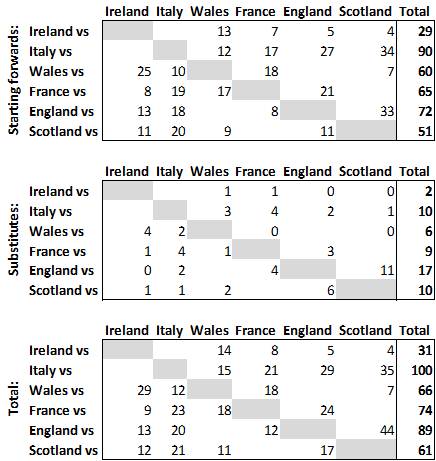
Do the stats back up such a view?  Oh me oh my, yes.  We looked at the number of passes given by forwards over the course of the Six Nations so far.  Ireland come out bottom of the table, but what’s particularly eye-catching is just how far they are behind even the second-last team.  Anyone wondering how Ireland have failed to turn pressure into points in the opposition’s 22 has a pretty good clue: Ireland’s forwards’ inability or unwillingness to pass the ball makes them an easy read for defenders.

It’s a scathing indictment of Ireland’s attack that their forwards pass so little, especially so given they have a backrow of O’Mahony, Heaslip and O’Brien.  Heaslip and O’Mahony in particular are exceptionally skilful players and how more cannot be made of their skillsets is staggering.  Are there mitigating circumstances?  Well, you could argue that the weather has been pretty awful, with both home games swept away in a deluge, but the conditions haven’t exactly been tropical for any of the other teams either.  Ireland lack tight forwards who are naturally good handlers, and it’s a pity Dan Tuohy’s season has been broken up by injury, because he is probably the best we have – not that he’d have been picked in any case.

It shouldn’t surprise anyone who has been watching to see Italy top the log.  Their commitment to moving the point of attack has been admirable, even if they lost their way in the middle of the series.  Sergio Parrisse’s total alone over three games is higher than all of Ireland’s.  England finish a surprising second, but their total is skewed by their performance against Scotland when they were feeling adventurous.  They’ve shut up shop since, settling for three-pointers to win games, although they have the highest number of passes by reserves, reinforcing the suggestion that their bench has been a significant factor in putting them on the verge of a slam.

To compound the misery, bear in mind that this is probably the lowest quality Six Nations in living memory, despite a good first weekend, dominated by treacly rugby played on roly-poly pitches.  The potential grand slammers can barely score a try.  It puts Ireland at the bottom of the bottom in terms of a desire to play attacking, incisive rugby.

The full horror is shown in the tables below.  Read each entry as the number of passes given by the team on the left in their match against the team above.

Source: ESPN

Source: ESPN

The Steve Walsh Show, and Ireland’s Backrow

Before we go through this game minute-by-minute, first let’s ask what the press made of the contribution of our back-row? The Sunday Times plaudits went to Peter O’Mahony – O’Reilly rates him highest (8, with 7’s for Sean O’Brien and Jamie Heaslip), crediting his impressive all-round game while Denis Walsh had POM as man of the match. The Sindo had Sean O’Brien in contention for the gong (with Murray). The press in Blighty made no mention of our hotly-debated backrow, restricting themselves to managing to staying awake as two bald men fight over a comb while ENGLAND sniff a Grand Slam.

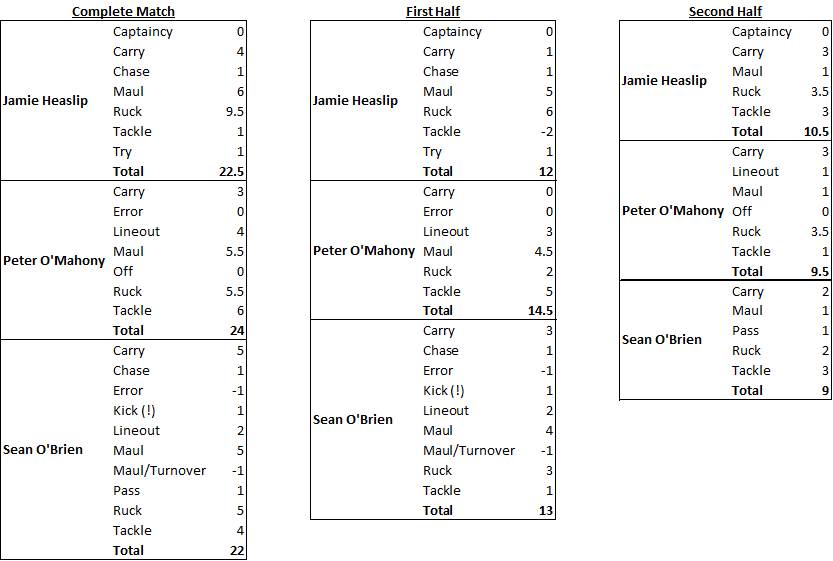
Based on the live Saturday viewing, we thought POM had his best game to date for Ireland, SOB was the highest class of the unit (what about that kick!) and Heaslip played with authority and continued his personal upturn in form in a green shirt. But will the statistics back it up? With due trepidation, we get reviewing ….

After cracking open two bottles of wine (Valpolicella Ripasso, in case you were wondering) and re-playing the entire game, stripping out Steve Walsh’s contributions, we have to say that the backrow appeared to work – it may not look conventional, but collectively they functioned well. All three men played well for the first time this series, and it was about as good as we have looked in that unit since Fez broke down.

We graded every action as:

  • +2: big play
  • +1: positive play
  • 0: neutral
  • -1: bad play
  • -2: awful play – a cross-field kick in your own 22 that goes straight to an opponent, for example

There are several things to note about our findings:

  1. Steve Walsh bestrode the match like a collossus – the man dominated the game, his tanned and ripped torso was rarely off-screen and he even refereed well – there was a clanger of a penalty on each side, but they balanced out. There was no shoving over of players, a la Conrad Smuth, but we were left in no doubt who was in charge – this was the Steve Walsh Show
  2. Morgan Parra’s passing was terrible – we have a lot more sympathy with Freddy than we did on first look, although he was rubbish too
  3. The volume of ruck inspecting by green shirts was ridiculous – either they don’t know what they are doing, or they do, and it’s rubbish. You would often have two green shirts in a ruck vs one blue, with two other green shirts inspecting – how can 11 men expect to break a 14-man defensive line?
  4. Donncha O’Callaghan’s tears during ‘Ireland’s Call’ were emotional. All the talk was of BOD, but this was likely Stakhanov’s last appearance in Lansdowne Road as well – whatever your opinion of him, 95 caps is a tremendous return and he will retire one of the most decorated players in our history. Hat tip.

What about her eyes the results, you say?

Well, looks like we picked the right week to stop sniffing glue.  All three men contributed hugely.  Our numbers have Peter O’Mahony scoring the most points by a cigarette paper, largely down to big turnovers (which got bonus points), but all three scored between 22 and 24 points – there’s some margin of error of course, and another review might place either of the other two in pole position, and we are sure people will disagree with some of our findings.  By the by, if we missed anything significant, please let us know.  We can attest to how tricky it is to capture every nuance of the match, especially in tight phases.

O’Mahony was the tidiest player, with only one error. He produced big plays when needed, two massive turnovers standing out, and (notably) didn’t start  any silly fights. His lineout work was good, and he tackled well.

Heaslip, as we suspected, was the groundhog/blindside groundhog – not always first to the ruck, but the most effective when he got there. Missed tackles were costly for Heaslip – two in two minutes against Kayser didn’t look good. As captain, we reviewed Heaslip’s decision-making (without awarding points) – with power comes responsibility. He was decisive and authoritative and looked, for the first time, a real leader. He trusted Jackson and the team seemed united and cohesive.

O’Brien was the most impactful player, and we feel we probably undersold his all-action excellence, but you live and die by the numbers. If you factor in the points earned for kicking and chasing, O’Brien scored the lowest pure back-row points, but he was almost Parisse-esque in his ubiquity at times.

Mauling was one of the big success stories of the day and all three were prominent, with good body positions and lots of aggression.  We awarded points for anyone who was in a maul which moved forwards, and there were plenty of them.  Heaslip in particular appears to excel at this element of the game, but all three were part of a huge mauling success.

All three players effectiveness declined in the second half, in tandem with Ireland’s in general. Some tables are below for your viewage.

NB: does not include Steve Walsh

NB: does not include Steve Walsh

NB: Steve Walsh's actions are broken down in the pdf file at the bottom

NB: Steve Walsh’s actions are broken down in the pdf file at the bottom

The complete analysis is below – feedback is welcomed and assumed, particularly from those who tweeted us at half-time from their high horse, assuming we’d make up stats to ensure O’Mahony wasn’t recognised – we expect a mea culpa below the line.

So, our preceonceptions turned out more or less correct.  Heaslip is the closest thing to an openside we have, but relies not so much on being the first man to the ruck, like a classic seven, but more on being the strongest man at the ruck.  O’Mahony plays like a No.8, and O’Brien is a carrying machine.  The numbers may be a jumble, but we seem to get away with it.

But one thing stuck out beyond all others.  Well though the three of them played, they were no match for Steve Walsh.  The tan, the arms, the demeanour, the chatty style, the mad new TMO rules he invented on the spot.  It’s Walsh’s world, the rest of us just live in it.

The full breakdown of every action is in the link below:

Backrow Stats – All Actions

Are you the best coach in the world?

This post is from our regular column in the Irish Post, the highest-selling newspaper for the Irish in Britain (which these days includes businessmen, lawyers and doctors, as well as Glasgow-bound day-tourists singing bigoted songs). The paper is published on Wednesday’s in Britain.

SO what now then? There is the slimmest sliver of a chance that Kidney’s contract will be renewed, and there are two factors at play: the conservatism of the Union, and the two remaining opponents in the Six Nations.

Starting with the two opponents, the key variable in Deccie’s favour is that both will be in our pool at RWC15 in England — France and Italy. If Ireland produce a commanding (and winning) display against the French, and slap Italy down in the manner of, say, 2007, any conservative waverers on whatever amateur committee decides these things will have a stick to grab hold of, and argue that Kidney’s Ireland are, in fact, well-placed to do well in the next World Cup.

And it’s the amateur conservatism that is important here — for we must consider what happens next. If Deccie refuses to resign (and why should he?), he has a contract until the end of the season, meaning that the lamest of lame duck coaches could be taking Ireland on a development tour to North America. The likes of Iain Henderson, Robbie Henshaw and Luke Marshall — who will be on or close to the first team in RWC15 — will essentially have a wasted summer, in development terms.

That Kidney badly wants to stay in the role is not in doubt. Forget his recent — and typical — unwillingness to give a straight answer to the question, and read between the lines of his actions instead.

Kidney’s current approach to selection and the captaincy has all the hallmarks of a man throwing money down in a casino, knowing he has little to lose. Having been wilfully conservative in matters of selection up until as recently as last summer, the 60-0 defeat in New Zealand appears to have flicked a switch in his head.

Now he’s changed the captain, thrown a 10 with place-kicking issues into an away test match for his debut, jettisoned Ronan O’Gara and persisted with media darling Craig Gilroy in spite of superior options being available — Luke Fitzgerald has a superior kicking and defensive game and is a good attacker, and Andrew Trimble is ahead in the Ulster pecking order due to his defence and workrate.

It looks like a slightly over-eager attempt to position himself as a forward-looking coach who has one eye on 2015, and therefore may just be the man to lead the team there. The trouble is none of it has worked so far.

What will happen in parallel? Will one of the Union’s amateur committees, and not the one who will be studying the recommendations of the professional review group (PRG, which has yet to meet) from last year, meet in the interim to decide who will be the manager from next season?

Or will they, like the English RFU, outsource the appointment to some expert group? If they don’t, can you imagine the top coaches, Vern Cotter or Fabien Galthie for example, explaining to a blazer how they plan to move forward with the team. Unlikely.

Appointment by those within means appointment from within, which means handing the reins to Mike Ruddock or Joe Schmidt. Ruddock has an under-20 RWC in June, and Schmidt has indicated next season will be his last in this hemisphere — neither is an easy transition, though the case for Schmidt is so strong as to be undeniable, and the Union should do everything it can to secure him for the role.

The path of least resistance actually seems to be to keep Kidney on, and hope for an upturn in performances — it’s stunning to think that such a lack of decisiveness might exist at the top of Irish professional rugby, but it’s not being run by professionals.

In fact, when we think about the process that is (probably) about to begin, it’s worth taking a step back and recalling the way the coaches of the Irish national side have been appointed since professionalism in 1995:

• Brian Ashton: chance phone call from his agent to Pat Whelan, hawking the “best coach in the world” — the Union took the bait, Murray Kidd was sent packing, and Ashton was given a SIX-YEAR contract. He stayed for one

• Warren Gatland: Gatty had spent time in Galway in the early 1990s, and he was flown over from NZ to coach Connacht after the Union balked at Eddie O’Sullivan’s request for contract stability. When Ashton was hastily disposed of, Gatty (one of only two provincial coaches in situ, a huge issue for Ashton) was promoted to the big gig

• Eddie O’Sullivan: Dagger joined Gatty’s team as attack coach in 2000, and the gradual improvement in performances was credited to the native rather than the Kiwi. After a(nother) November defeat to New Zealand, the Union changed ships — silverware followed

• Declan Kidney: Deccie was Eddie’s number two for a couple of seasons, but that was never going to work — that experience allowed him to press for his own coaching team, which delivered first time up. But Deccie himself only got the nod after a trawl of available Southern Hemisphere coaches revealed nought.

When we consider that the man (Whelan) who piloted the first appointment of the professional era, that of Ashton, is likely to be involved in the next one, we aren’t filled with confidence.

What should happen is the roles in-scope of a national coach should be defined, as should the targets and reporting structure (which should be to the director of rugby sanctioned by the PRG) — then a suitable candidate sought.

The entire process is fundamentally flawed — no one knows what Deccie’s job targets are, no one can say what the new coaches should be doing, and the edifice that has taken Irish rugby through the first generation of professional players is crumbling.
Right now, all work is still being conducted by amateurs — as well-meaning as they might be, it ain’t gonna work in this day and age.